

Are you a US marketer juggling tight budgets, algorithm changes, and the pressure to show ROI quickly? You’ve probably asked yourself: Should I pour energy into evergreen vs trending content marketing? One type builds steady traffic for years. The other can explode overnight but often fades just as quickly.
In 2026, smart marketers in New York, Chicago, Los Angeles, and small-town America know the secret isn’t choosing one or the other—it’s balancing both. This guide breaks down evergreen content vs. timely content, shows real examples, and gives you simple, actionable steps to grow organic traffic while staying relevant. Whether you’re a beginner or running campaigns for a national brand, you’ll walk away with a clear content marketing strategy (evergreen vs. trending) that actually works.
Let’s dive in.
What Is Evergreen Content in Marketing?
Evergreen content is like that reliable friend who’s always there when you need advice. It answers questions that people keep asking—no matter the season or the latest TikTok trend.
Think “how to file taxes as a small business owner in the USA” or “the best email marketing tools for beginners.” These topics don’t expire. According to 2026 data, evergreen posts make up 75% of total blog traffic for many sites and deliver 3x more traffic than time-sensitive articles.
Evergreen content vs timely content is simple: evergreen stays useful for months or years; timely content rides the wave of current events and dies out fast.
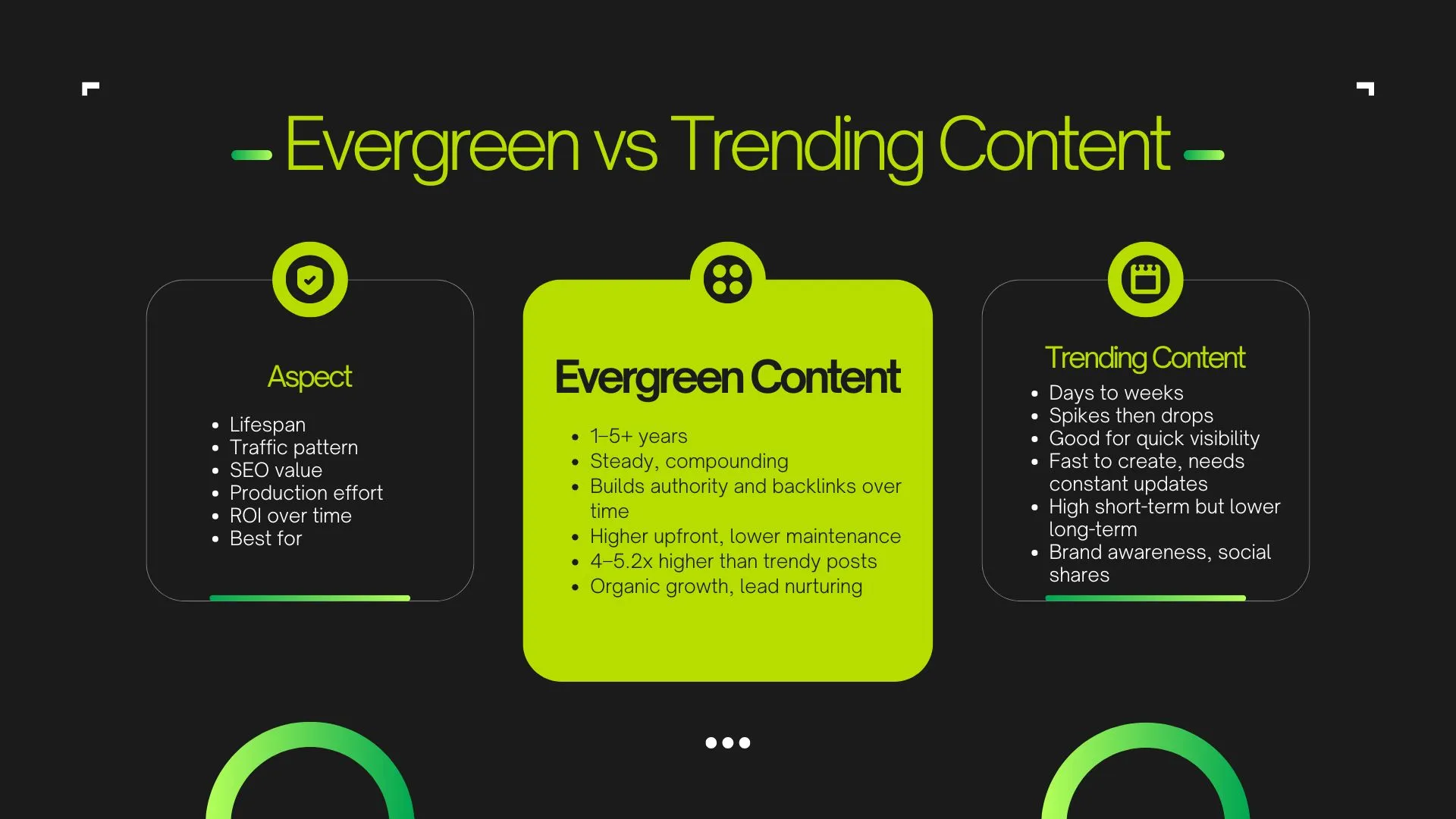
Evergreen vs Trending Content: The Core Differences
Here’s a quick side-by-side look at evergreen vs trending content marketing:
Aspect | Evergreen Content | Trending Content |
Lifespan | 1–5+ years | Days to weeks |
Traffic pattern | Steady, compounding | Spikes then drops |
SEO value | Builds authority and backlinks over time | Good for quick visibility |
Production effort | Higher upfront, lower maintenance | Fast to create, needs constant updates |
ROI over time | 4–5.2x higher than trendy posts | High short-term but lower long-term |
Best for | Organic growth, lead nurturing | Brand awareness, social shares |
The evergreen vs viral content differences are even clearer: viral content spreads because it’s funny or shocking right now. Evergreen content spreads because it solves real problems forever. Both have a place, but mixing them wrong wastes time and money.
Benefits of Evergreen Content Marketing
US marketers who focus on evergreen see real wins:
- Consistent organic traffic growth strategies: One strong guide can bring visitors every single day without extra ad spend.
- Lower customer acquisition cost: Evergreen assets keep working while paid campaigns stop the moment you turn them off.
- Higher content ROI over time: Studies show evergreen content returns up to 2 times the investment compared with seasonal posts.
- Stronger search intent in content marketing: Google loves pages that stay relevant, which improves rankings and keyword sustainability in SEO.
Plus, evergreen content fights content decay—that slow drop in traffic that happens when old posts go stale. A quick annual update keeps them fresh.
SEO Benefits of Evergreen Content
Google’s ranking factors still reward content freshness vs content longevity. Evergreen pages rank higher longer because they match ongoing search intent.
In the United States, where local SEO matters for everything from “plumbers near me” to “digital marketing tips for small businesses in Texas,” evergreen blog posts become local authority magnets. They attract backlinks, earn featured snippets, and drive blog content that drives consistent traffic.
Real talk: 60% of marketers now prioritize evergreen content precisely because it supports content optimization for long-term traffic.
Long-Term vs Short-Term Content Strategy: Finding Your Balance
The smartest content marketing strategy, evergreen vs. trending, follows the 70/30 rule (or even 80/20 for education-focused brands).
- 70–80% evergreen → foundation of your site
- 20–30% trending → keeps things fresh and human
This mix gives you content lifecycle marketing strategy success: create once, update occasionally, and repurpose everywhere.
When to Use Trending Content in Marketing
Trending content shines when you need fast results. Use it for:
- Product launches
- Major news events
- Seasonal sales (Black Friday, back-to-school)
- Real-time cultural moments
A trending content strategy for brands works best as the spark that drives people into your evergreen funnel. A viral post about “AI tools everyone is using right now” can introduce readers to your timeless “Ultimate Guide to Choosing AI Tools for Small Businesses.”
How to Create Trending Content (Without Burning Out)
- Set up daily Google Alerts and social listening tools.
- React within hours—not days.
- Keep your brand voice consistent.
- Add a link to an evergreen piece at the end.
- Repurpose the trending post into short videos or Threads for maximum reach.
Remember, creating trending content is about speed plus strategy, not just jumping on every trend.
Evergreen Content Examples for Blogs + Ideas for Marketers
Looking for evergreen blog post ideas for marketers? Here are proven winners:
- “How to Build a Content Calendar That Actually Works in 2026”
- “10 Email Marketing Templates Every US Small Business Needs”
- “Local SEO for Brick-and-Mortar Stores: A Beginner’s Guide”
- “Content Planning for Evergreen Content: Step-by-Step Checklist”
- “Pillar Content vs Trending Posts: How to Use Both”
These examples keep generating traffic because they solve search intent in content marketing that never changes.
Content Planning for Evergreen Content
Create a simple system:
- Audit your existing content every quarter.
- Identify content decay (pages losing traffic).
- Update with fresh stats, new screenshots, and 2026 best practices.
- Build topic clusters around pillar pages.
- Use a content calendar strategy for marketers that blocks 70% of slots for evergreen work.
Tools like Google Search Console (free for every US marketer) show exactly which pages need love.
Real-Time Marketing Content Examples That Worked
- Oreo’s famous “You can still dunk in the dark” tweet during the 2013 Super Bowl blackout still gets referenced in 2026 case studies.
- Wendy’s witty real-time roasts on X continue to drive engagement and send traffic to evergreen menu guides.
- During 2025–2026 storms, brands like Duracell posted “Power outage checklist” content that mixed trending weather news with evergreen preparedness advice.
These real-time marketing content examples prove one thing: trending posts work best when they lead people back to your evergreen assets.
Audience Engagement Trends and Content Freshness vs Content Longevity
In 2026, audience engagement trends show US readers crave both speed and substance. Short-form video gets clicks, but long-form evergreen guides build trust and loyalty.
While Google still considers content freshness signals, it also rewards content longevity. The winning formula? Publish evergreen first, then layer timely updates and trending hooks on top.
Pillar Content vs Trending Posts in Your Strategy
Pillar content is the ultimate evergreen format—comprehensive guides that cover a broad topic. Trending posts act as supporting blog content that links back to the pillar. Together they create a powerful inbound marketing content strategy.
My Real-World Experience Learning Digital Marketing
When I first started learning digital marketing, terms like SEO, Google Ads, and content marketing felt overwhelming. I honestly thought this field was only for tech experts, but with consistent practice, I realized that beginners can learn digital marketing step by step. In the beginning, I made the mistake of trying to learn everything at once, which only created confusion. My understanding improved significantly once I focused on one skill at a time, especially the basics of SEO. While learning SEO, I discovered that simply adding keywords is not enough. I noticed organic traffic from the United States slowly growing after I began writing content to genuinely help users. Many students enter digital marketing expecting quick income, but based on my experience, focusing on learning and real practice first always leads to better long-term results. Using tools like Google Search Console helped me understand what people are actually searching for. At first, it felt confusing, but regular use made it easier to analyze real user behavior. At one point, I focused too much on writing for search engines instead of real readers. Once I shifted my approach to helping people first, my content performance improved. If you are a student or beginner, digital marketing can be a realistic and future-proof career, as long as you stay patient and trust the learning process instead of chasing shortcuts.
Conclusion: Build Your Winning Content Mix Today
Evergreen vs trending content marketing isn’t a battle—it’s a partnership. Evergreen gives you the steady foundation every US marketer needs for sustainable growth. Trending content adds excitement, timeliness, and social proof.
Start small. Audit your site this week. Pick one evergreen topic your audience searches for every month. Write it with care. Then experiment with one trending hook that drives traffic back to it.
Your future self—and your analytics dashboard—will thank you.
Ready to build a content strategy that actually lasts? Drop your biggest evergreen vs trending question in the comments or book a free 15-minute strategy call with our team. Let’s make things that work while you sleep.
FAQs
What is the main difference between evergreen content vs timely content?
Evergreen content stays relevant for years while timely content is tied to current events and loses value quickly.
How much evergreen content should I create versus trending content?
Most experts recommend a 70–80% evergreen and 20–30% trending mix for the best long-term results.
What are the SEO benefits of evergreen content?
Evergreen pages rank higher for longer, attract steady organic traffic, and earn more backlinks over time.
Can small businesses in the USA use evergreen content effectively?
Absolutely. Local SEO topics like “how to choose a web designer in [your city]” make perfect evergreen assets.
How do I update evergreen content to prevent content decay?
Check Google Search Console quarterly, refresh statistics, add new examples, and update the publish date.
What are excellent evergreen blog post ideas for marketers?
Try “How to Create a Content Calendar,” “Email Marketing Best Practices,” or “Beginner SEO Checklist for 2026.”
When should brands use a trending content strategy?
Use trending content for product launches, major news, or cultural moments—then link back to your evergreen resources.
Does Google still reward content freshness in 2026?
Yes, but it also values content longevity. The smartest strategy combines both.
How do I measure content ROI over time?
Track organic traffic, leads, and sales from each piece using Google Analytics and UTM tags over 12–24 months.
Is viral content the same as trending content?
Not exactly. Viral is about massive short-term shares; trending is about riding timely topics. Both differ from Evergreen’s steady approach.
✍️ Author Bio (E-E-A-T Fix)
Written by Techlo Solution
Digital Marketing Learner & SEO Practitioner
Helping beginners and students understand online marketing in simple words.