
Traditional vs Digital Marketing:
Let’s be honest the debate between traditional marketing and digital marketing is no longer a fair fight. For decades, businesses reckoned on billboards, newspaper advertisements, television commercials, and radio spots to reach their cult. These styles worked and in some niches, they still do. But in 2026, the game has unnaturally changed. The question is no longer whether to invest in digital marketing, but how important and where.
This article breaks down the real differences between traditional and digital marketing, backed by data, case studies, and practical perceptivity so that whether you’re a small business proprietor, startup founder, or marketing professional, you’ll walk down knowing why digital marketing is no longer voluntary.
What’s Traditional Marketing?
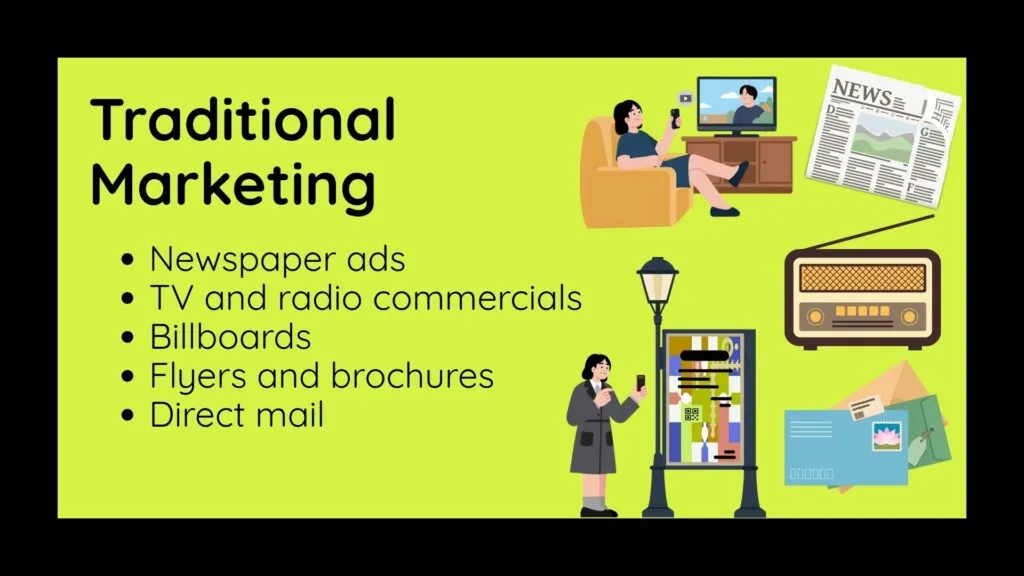
Traditional marketing refers to any type of creation that uses offline channels to reach guests. This includes print advertising in newspapers and magazines, television and radio advertising, direct mail (flyers, brochures, postcards), out-of-door advertising similar as billboards and banners, and telemarketing.
These methods have been the backbone of business creation for further than a century. A full- runner announcement in a public review or a 30-alternate high- time television spot can make or break a product launch. Major brands like Coca- Cola, Nike, and McDonald’s erected their global empires largely through traditional advertising.
But then’s a crucial problem Traditional marketing offers nearly zero measurement. You spend thousands of dollars on a billboard — how do you know how numerous people saw it? How numerous were in your target age group? How numerous people entered your store because of it? The honest answer is you do not know. And in 2026, operating without data is a serious competitive disadvantage.
What’s digital marketing?
Digital marketing encompasses all marketing efforts that use the internet and electronic devices. It includes hunt machine optimization (SEO), pay- per- click advertising (PPC), social media marketing, email marketing, content marketing, influencer marketing, chapter marketing, and video marketing on platforms like YouTube, TikTok, and Instagram Reels.
The main advantage of digital marketing is real- time data and precise targeting. When you run a Facebook announcement, you can target users by age, position, interests, online gest, income position, and dozens of other parameters. You know incontinently when someone clicks on your Google announcement. When your blog post hits the frontal page of Google, you track exactly how numerous visitors it brings in and what they do on your site.
This level of insight was simply insolvable with traditional marketing and that’s what makes digital selling the dominant force in 2026.
Traditional vs Digital Marketing: Head-to-Head Comparison
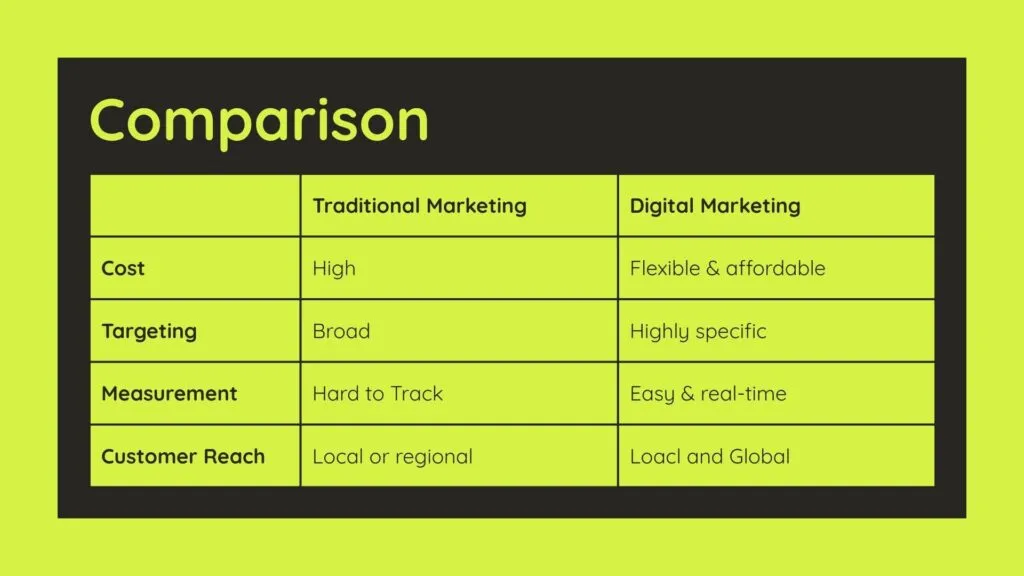
Factor | Traditional Marketing | Digital Marketing |
Cost | High (TV ads can cost $100K+) | Flexible — starts from $1/day |
Audience Targeting | Broad, demographic-based | Hyper-precise, behavior-based |
Measurability | Very difficult to track ROI | Full analytics & tracking |
Reach | Local or national | Global, 24/7 |
Engagement | One-way communication | Two-way, interactive |
Speed | Slow (weeks to launch) | Instant (go live in minutes) |
Personalization | Very limited | Highly personalized |
Flexibility | Hard to edit once published | Can be changed in real time |
Competition Level | Limited to local businesses | Global competition, higher stakes |
Why Traditional Marketing Is Losing Ground in 2026
This is n’t about fully rejecting traditional marketing. A well- placed billboard near a highway or a full- page announcement in a trade magazine can still be effective in certain surrounds. But several major changes have dramatically reduced its effectiveness for utmost businesses
1. The attention economy has shifted online.
The average person spends further than 6 hours a day online — browsing social media, watching videos, reading blogs, and shopping. Television viewership is steadily declining, newspapers are closing, and radio has largely been replaced by podcasts and streaming. Consumer attention is online, and smart businesses are following the attention.
2. Ad Blocking and Banner Blindness
Indeed within digital media, traditional- style banner advertising faces wide announcement blocker operation — over 40 of internet users encyclopedically block advertisements. This means businesses need to produce authentically precious content (blogs, vids, social posts) rather than disruptive distractions. Traditional print and television ca n’t keep up with this behavioral shift — digital marketing can.
3. The cost barrier for small businesses is enormous.
A 30-alternate television commercial during high time can bring anywhere from$ 50,000 to over$ 5 million during events like the Super Bowl. A small bakery, original fitness plant, ore-commerce startup ca n’t contend with these terms. Digital marketing democratizes access — a$ 500/ month budget on Google Advertisements or Meta Advertisements can produce significant, measurable results.
“In 2026, the most important marketing tool you have is a well- optimized website, a strong social media presence, and a harmonious content strategy- none of which bear a million- dollar budget.”
Case Study
Case Study Warby Parker- From Zero to$ 3 Billion without Traditional Advertising
When Warby Parker launched as an online eyewear brand in 2010, they had no retail presence and no television budget. Their entire growth strategy was erected on SEO, social media marketing, influencer partnerships, and a viral home try- on program that spread through online word of mouth. By using content marketing and structure real communities on Instagram and Pinterest, Warby Parker came a$ 3 billion company- proving that digital-first brands can beat traditional giants without a single billboard.
The pillars of digital marketing that every business should use.
Search Engine Optimization (SEO)
SEO is the process of optimizing your website so it ranks grandly on Google and other search engines for your users’ keywords. In 2026, with AI- powered hunt results (Google SGE), SEO has come indeed more important with a focus on topical authority-E-A-T (Experience, moxie, Authority, Trust), and high- quality content that truly responds to user intent. Organic search traffic is free, sustainable, and frequently converts better than paid advertising.
Social Media Marketing
Platforms like Instagram, TikTok, LinkedIn, Facebook, YouTube, and X (Twitter) give unknown reach to targeted cult. In 2026, short- form video content dominates. Brands that produce authentic, value- driven content constantly outperform those running stationary image advertisements. Social media marketing also builds brand loyalty and community — something no billboard can achieve.
Email Marketing
Despite being one of the oldest digital channels, email marketing constantly delivers the loftiest ROI of any digital strategy a normal of$ 42 for every$ 1 spent. Erecting an email list is about creating a direct line to your followership that no algorithm can. In 2026, with AI- powered personalization, email campaigns could be largely applicable to individual subscribers.
Content Marketing
Content marketing — blog posts, videos, podcasts, infographics, and case studies is the foundation for long- term digital visibility. By constantly publishing precious, SEO-friendly content, businesses establish authority in their industry, drive organic traffic, and nurture implicit guests through the buying journey.
Pay- Per- Click Advertising (PPC)
Google Advertisements and Meta Advertisements allow businesses to reach consumers ready to buy incontinently. Unlike traditional advertising where you pay a fixed rate anyhow of results, PPC advertisements only charge you when someone clicks on your announcement. Advanced AI bidding systems in 2026 make these platforms smarter than ever — maximizing conversions while reducing wasted spend.
Will traditional marketing still have a role in 2026?
It’s a fair and important question. The honest answer is yes, but veritably little and only for specific scenarios.
veritably large brands running mindfulness juggernauts( Super Bowl advertisements, Olympic auspices), original businesses that are less active online, those targeting aged demographics, industries with strict digital advertising restrictions( some pharmaceutical, fiscal, and legal sectors), and events or experiences that bear a trade show, trade show, or trade fair.
Indeed in these cases, still, traditional marketing works best when integrated with digital marketing. A television commercial that takes observers to a website, a billboard with a QR law, or a direct correspondence piece with a unique wharf runner URL — these mongrel approaches harness the power of both worlds.
Pro Tip for 2026
Still, always pair it with a digital shadowing mechanism — a unique URL, a QR code, If you’re running any form of traditional advertising. That way, you can actually measure the ROI of your offline efforts and make data- driven opinions about where to allocate your budget.
How to make a Digital Marketing Strategy for International Traffic in 2026.
Then’s a proven framework if your thing is to drive transnational traffic to your website and make a encyclopedically honored brand
- Step 1 — Build a Fast, Mobile- Optimized Website
Your website is your global storefront. It should load in under 3 seconds on mobile devices, be optimized for core web vitals, have a clear navigation structure, and offer content in multiple languages if targeting on-English markets. In 2026, Google’s ranking algorithm will put heavy penalties on slow, unresponsive websites.
- Step 2– Invest in transnational SEO.
Transnational SEO involves keyword research for each target country, enforcing reflag tags, erecting original backlinks, and creating culturally applicable content. Ranking on Google.com is great but ranking on Google.co.uk, Google.de, or Google.com.au requires specific localization efforts.
- Step 3 — Create shareable, high- value content.
Content that educates, entertains, or solves problems travels internationally without borders. In- depth blog posts, YouTube tutorials, data- driven infographics, and expert interviews attract backlinks from around the world which directly improves your domain authority and search rankings encyclopedically.
- Step 4 — Leverage social media for global reach.
Produce a harmonious presence on platforms that are dominant in your target markets. LinkedIn is the king of B2B encyclopedically. Instagram and TikTok dominate consumer brands in the US, UK, Europe, and South Asia. YouTube transcends all demographics and languages. Constantly posting with platform-specific content formats is crucial to erecting a transnational social media following.
- Step 5 — Run targeted global announcement juggernauts.
Google Advertisements and Meta Advertisements allow you to target specific countries, cities, and indeed neighborhoods with acclimatized messaging. Running campaigns in the US, UK, Canada, and Australia — English- speaking markets with high purchase intent — can drive significant transnational traffic to your website.
Conclusion The future belongs to digital-first businesses.
In 2026, thriving businesses are those that understand where their guests are and constantly show up there. The days of counting solely on traditional marketing — billboards, print advertisements, and cold calls are over. Not because those styles are fully dead, but because they can no longer contend with the perfection, scalability, and measurability of digital marketing.
Whether you’re a one- person startup dealing hand wrought items on Etsy, amid-sized-commerce brand trying to break into the U.S. Request, or an established company looking to grow internationally — digital marketing is your most important tool. It levels the playing field, connects you to your exact ideal client, and delivers real, trackable results.
The question is n’t whether you can go to invest in digital marketing in 2026. The question is whether your business can go it.
Get started today. Make your SEO foundation. Produce harmonious content. Engage your followership on social media. Launch smart advertising campaigns. And watch your business grow — from original to global, from unknown to indelible.

Conclusion: Adapt Now or Fall Behind
Businesses relying solely on traditional marketing will struggle by 2026.
Businesses that embrace digital marketing for entrepreneurs, local SEO, online advertising, andbdata-driven strategies will win market share.
 Call-to-Action (CTA) Click Here
Review your current marketing strategy
Shift budget from low-performing traditional ads
Invest in digital marketing channels that deliver measurable growth
The future belongs to businesses that market smarter, not harder.
FAQs – Traditional vs Digital Marketing (SEO)
What is the main difference between traditional and digital marketing?
Traditional marketing is offline and broad, while digital marketing is online, targeted, and measurable.
Is traditional marketing still effective in 2026?
It can support brand awareness, but digital marketing delivers better ROI and growth.
Why is digital marketing better for small businesses?
It is affordable, scalable, and allows precise targeting with clear results.
Can small businesses combine traditional and digital marketing?
Yes, but digital marketing should be the primary focus.
Which marketing strategy is best for entrepreneurs in the USA?
A combination of SEO, email marketing, paid ads, and social media works best.
My Real-World Experience Learning Digital Marketing
When I started writing content to genuinely help users, I noticed organic traffic from the United States slowly growing. Many students enter digital marketing expecting quick income, but based on my experience, focusing on learning and real practice first always leads to better long-term results. Using tools like Google Search Console helped me understand what people are actually searching for. At first, it felt confusing, but regular use made it easier to analyze real user behavior. At one point, I focused too much on writing for search engines instead of real readers. Once I shifted my approach to helping people first, my content performance improved.
If you are a student or beginner, digital marketing can be a realistic and future-proof career, as long as you stay patient and trust the learning process instead of chasing shortcuts.
 Author Bio (E-E-A-T Fix) Click Here
Written by Techlo Solution
Digital Marketing Learner & SEO Practitioner
Helping beginners and students understand online marketing in simple words.