
Running a business in 2026 means one thing is clear: if you can’t measure your marketing, you can’t grow it.

Marketing Goals & KPIs Explained in 2026

A Practical, ROI-Focused Guide for Business Owners in the United States

Running a business in 2026 means one thing is clear: if you can’t measure your marketing, you can’t grow it.

Many US business owners invest in websites, ads, social media, or SEO but still ask:

  • “Is my marketing actually working?”
  • “Which numbers really matter?”
  • “Am I getting something back for the money I spend on marketing?”

The answer lies in understanding marketing goals and KPIs.

This guide explains marketing goals & KPIs in 2026 in simple English, with real examples, clear frameworks, and actionable tips, especially for business owners and decision-makers, not just marketers.

What Are Marketing Goals and KPIs? (Simple Explanation)

Marketing Goals

Marketing goals define what you want to achieve.

Examples:

  • Increase online sales
  • Get more qualified leads
  • Improve brand awareness
  • Reduce customer acquisition cost

Good goals are measurable marketing goals, not vague wishes.

KPIs (Key Performance Indicators)

KPIs are the numbers that show whether you are achieving those goals.

Examples:

  • Website conversion rate
  • Cost per lead
  • Customer acquisition cost (CAC)
  • Return on marketing spend

Together, marketing goals and KPIs keep your strategy focused, accountable, and profitable.

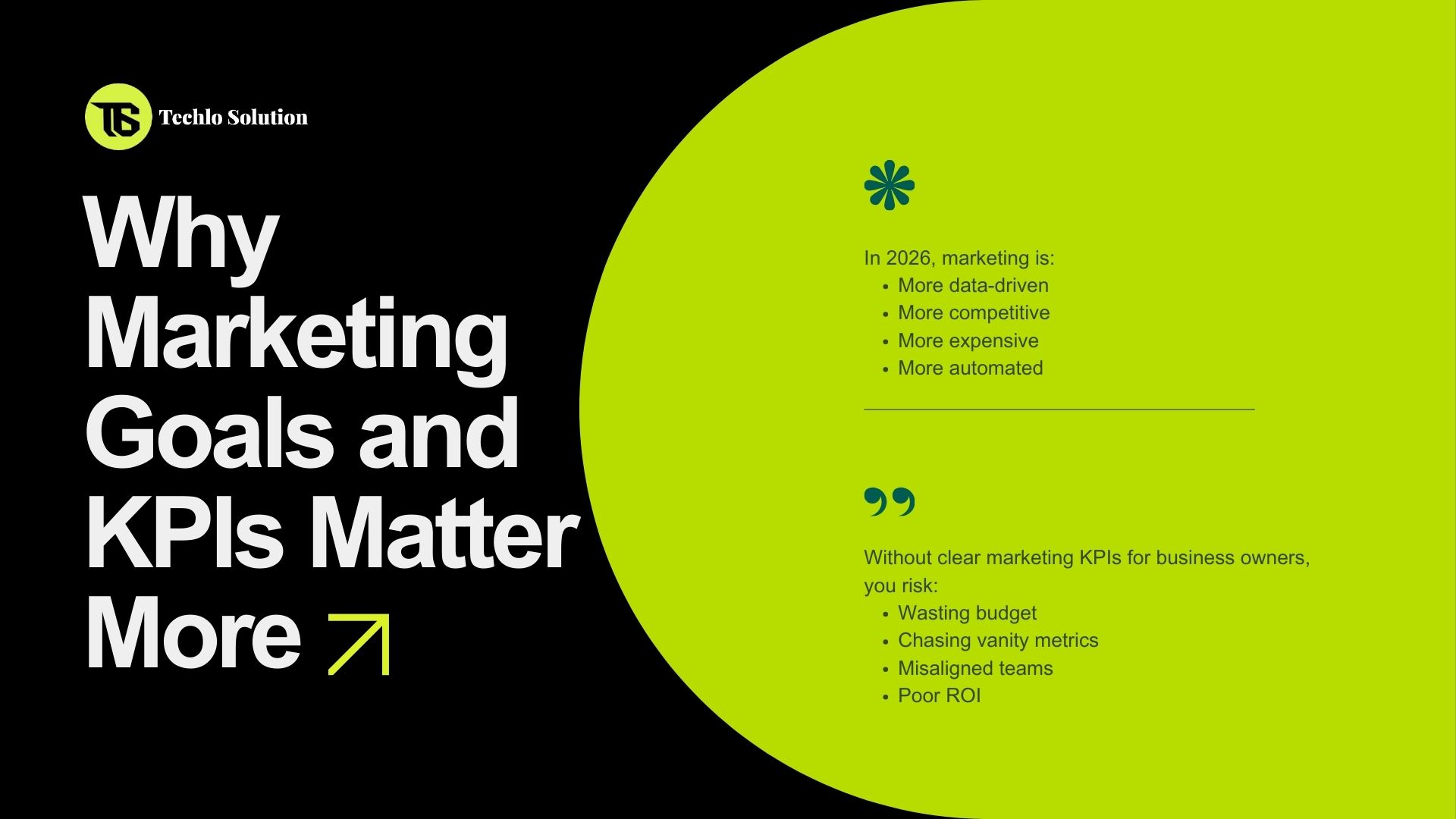
Why Marketing Goals and KPIs Matter More in 2026

In 2026, marketing is:

  • More data-driven
  • More competitive
  • More expensive
  • More automated

Without clear marketing KPIs for business owners, you risk:

  • Wasting budget
  • Chasing vanity metrics
  • Misaligned teams
  • Poor ROI

Businesses that track the right KPIs consistently outperform those that don’t—especially in the US market.

Marketing Goals vs KPIs: What’s the Difference?

Marketing Goals

Marketing KPIs

The destination

The measurement

Strategic

Tactical

Long-term focus

Ongoing tracking

“Increase sales”

“Conversion rate, CAC, revenue”

You need both for a revenue-driven marketing strategy.

How to Set Marketing Goals and KPIs (Step-by-Step)

Step 1: Align Marketing Goals with Business Goals

Marketing should support business outcomes, not just activity.

Examples:

  • Business goal: Grow revenue by 20%
  • Marketing goal: Generate 30% more qualified leads

This alignment improves sales and marketing alignment.

Step 2: Use SMART Marketing Goals

SMART goals are:

  • Specific
  • Measurable
  • Achievable
  • Relevant
  • Time-bound

Example:

“Increase website leads by 25% in 6 months from US-based traffic.”

This framework is essential in business marketing goals frameworks.

Step 3: Choose KPIs That Actually Matter

Avoid tracking everything. Focus on marketing KPIs that matter.

Ask:

  • Does this KPI influence revenue?
  • Can we take action from it?
  • Is it relevant to our growth stage?

Marketing Goals and KPIs Examples (Realistic & Practical)

Example 1: Local Service Business (USA)

Goal: Get more local customers
KPIs:

  • Google Business Profile calls
  • Local SEO rankings
  • Conversion rate from local traffic

Example 2: E-commerce Business

Goal: Increase online sales
KPIs:

  • Conversion rate optimization metrics
  • Average order value
  • Marketing ROI KPIs

Example 3: B2B Company

Goal: Generate qualified leads
KPIs:

  • Lead generation KPIs
  • Cost per lead
  • Sales-qualified leads (SQLs)

These marketing goals and KPI examples help turn strategy into action.

Digital Marketing KPIs for Small Businesses (2026)

For small and medium businesses, simplicity matters.

Core Digital Marketing KPIs for Small Businesses

  • Website traffic (quality, not volume)
  • Conversion rate
  • Cost per lead
  • Customer acquisition cost (CAC)
  • Customer lifetime value (CLV)
  • Email open & click rates

These KPIs support tracking marketing performance without complexity.

Funnel-Based Marketing Metrics Explained

Modern marketing uses funnels, not isolated channels.

Funnel-Based KPIs

  • Awareness: Impressions, reach, brand awareness metrics
  • Consideration: Time on site, engagement
  • Conversion: Conversion rate, CPA
  • Retention: CLV, repeat purchase rate

This approach supports end-to-end performance tracking.

Marketing Performance Metrics Explained (Without Jargon)

Here are key KPI metrics for marketing success, explained simply:

  • CAC (Customer Acquisition Cost):
    How much do you pay to get one customer?
  • CLV (Customer Lifetime Value):
    Total revenue from a customer over time.
  • Conversion Rate:
    % of users who take action.
  • Marketing ROI:
    Revenue generated ÷ marketing spend.

These metrics help owners make smarter decisions.

How to Track Marketing KPIs Effectively

Use Simple Tools

You don’t need enterprise software.

Recommended tools:

  • Google Analytics
  • Google Search Console
  • CRM dashboards
  • Email marketing reports

These tools support marketing analytics basics for non-technical users.

Build a KPI Dashboard for Marketing

A simple KPI dashboard for marketing should show:

  • Goals vs actual results
  • Trends over time
  • Channel performance

One dashboard = better decisions.

KPI Benchmarking: Know What “Good” Looks Like

KPI benchmarking helps you understand whether your performance is strong or weak.

Examples (varies by industry):

  • Website conversion rate: 2–5%
  • Email open rate: 20–30%
  • Paid ads CTR: 1–3%

Benchmarks guide improvement but don’t replace strategy.

Common Marketing KPI Mistakes Business Owners Make

Avoid these errors:

  • Tracking vanity metrics only
  • No clear goals
  • Too many KPIs
  • Ignoring data insights
  • Not reviewing KPIs regularly

Strong marketing reporting for business owners avoids these traps.

Marketing Goals and KPIs Trends in 2026

Key trends shaping measurement:

  • AI-driven analytics
  • Predictive performance models
  • Revenue-first KPIs
  • Privacy-first tracking
  • Real-time dashboards

Modern businesses focus on growth metrics for businesses, not just traffic.
My Real-World Experience Learning Digital Marketing

When I first started learning digital marketing, terms like “KPIs,” “conversion rates,” and “analytics” felt confusing. I initially focused only on activities, writing content, adding keywords, and publishing posts without understanding how success was measured. Over time, I realized that without clear marketing goals and KPIs, effort alone doesn’t lead to results.

As I began using tools like Google Search Console, I learned how users from the United States actually found and interacted with content. At one point, I focused too much on rankings instead of meaningful KPIs like engagement and conversions. Once I shifted my mindset to tracking performance metrics that mattered, my understanding of marketing improved significantly. This experience taught me that learning digital marketing or running a business requires patience, data-driven thinking, and a focus on real outcomes rather than shortcuts.

How Business Owners Should Review Marketing KPIs

Best practice:

  • Review KPIs monthly
  • Compare with goals
  • Identify one improvement area
  • Adjust strategy not panic

Consistency beats perfection.

Conclusion: Marketing Goals and KPIs Are Your Growth Compass

In 2026, successful businesses don’t guess; they measure.

Understanding marketing goals and KPIs helps US business owners:

  • Improve ROI
  • Control marketing spend
  • Align teams
  • Scale confidently

Call-to-Action (CTA)

  • Write down your top 3 marketing goals
  • Choose 5 KPIs that connect to revenue
  • Track them consistently for 90 days

Clear goals + the right KPIs = smarter growth.

FAQs – Marketing Goals & KPIs (SEO)

What are marketing goals and KPIs?

Goals define what you want to achieve; KPIs measure progress.

How many marketing KPIs should a business track?

5–10 focused KPIs are enough for most businesses.

Are KPIs different for small businesses?

Yes, small businesses should focus on simple, revenue-related KPIs.

How often should KPIs be reviewed?

Monthly reviews work best for most US businesses.

Do KPIs guarantee marketing success?

No, but they help you make better decisions faster.

✍️ Author Bio (E-E-A-T)

Written by Techlo Solution
Digital Marketing Learner & SEO Practitioner
Helping beginners, students, and business owners understand online marketing in simple words.
 

The way customers discover, evaluate, and buy products has changed dramatically—and in 2026, it’s more complex than ever.

Understanding the Digital Customer Journey in 2026

A Practical, Future-Ready Guide for Marketers in the United States

The way customers discover, evaluate, and buy products has changed dramatically—and in 2026, it’s more complex than ever.

Customers no longer follow a straight line from ad to purchase. Instead, they move across search engines, social media, email, websites, apps, and offline touchpoints, often switching devices and channels multiple times.

This is why understanding the digital customer journey in 2026 is critical for marketers who want to stay relevant, competitive, and profitable in the US market.

In this guide, you’ll learn:

  • What the modern digital customer journey looks like in 2026
  • How to map and optimize it step by step
  • How AI, data, and personalization are reshaping customer behavior
  • Practical frameworks for B2C and B2B marketers

This article is written in simple English, with real examples, actionable tips, and USA-focused insights.

What Is the Digital Customer Journey in 2026?

The digital customer journey is the complete experience a customer has with your brand—from first awareness to long-term loyalty—across all digital channels.

In 2026, the journey is:

  • Non-linear (customers jump between stages)
  • Omnichannel (online + offline touchpoints)
  • Data-driven (powered by analytics and AI)
  • Personalized (different for every user)

This shift has changed how marketers approach customer journey strategy for digital marketing.


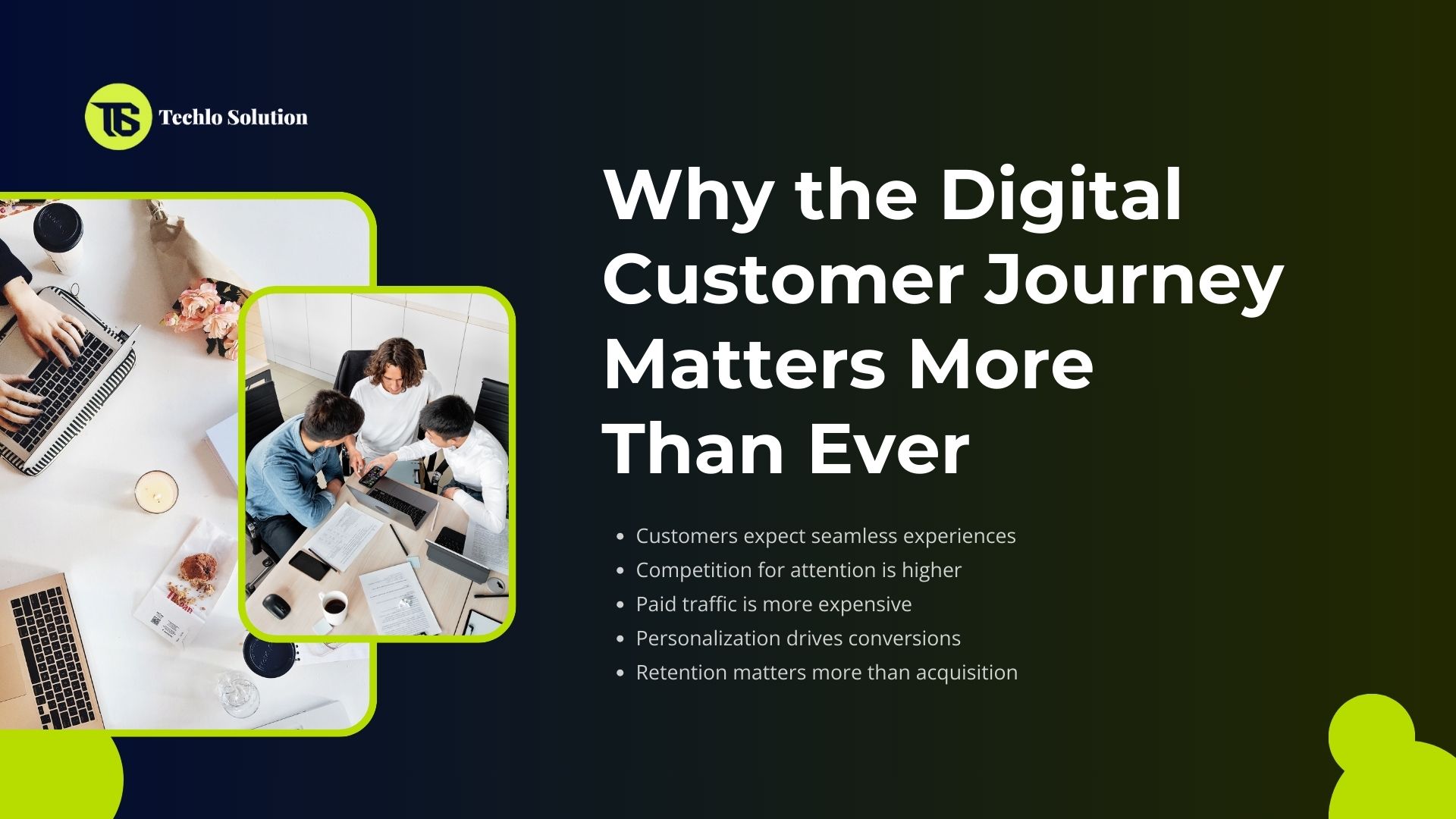
Why the Digital Customer Journey Matters More Than Ever

Marketers who understand the modern digital customer journey gain a major advantage.

Key Reasons:

  • Customers expect seamless experiences
  • Competition for attention is higher
  • Paid traffic is more expensive
  • Personalization drives conversions
  • Retention matters more than acquisition

In the US market, brands that invest in end-to-end digital customer journey optimization consistently outperform those focused only on traffic or ads.

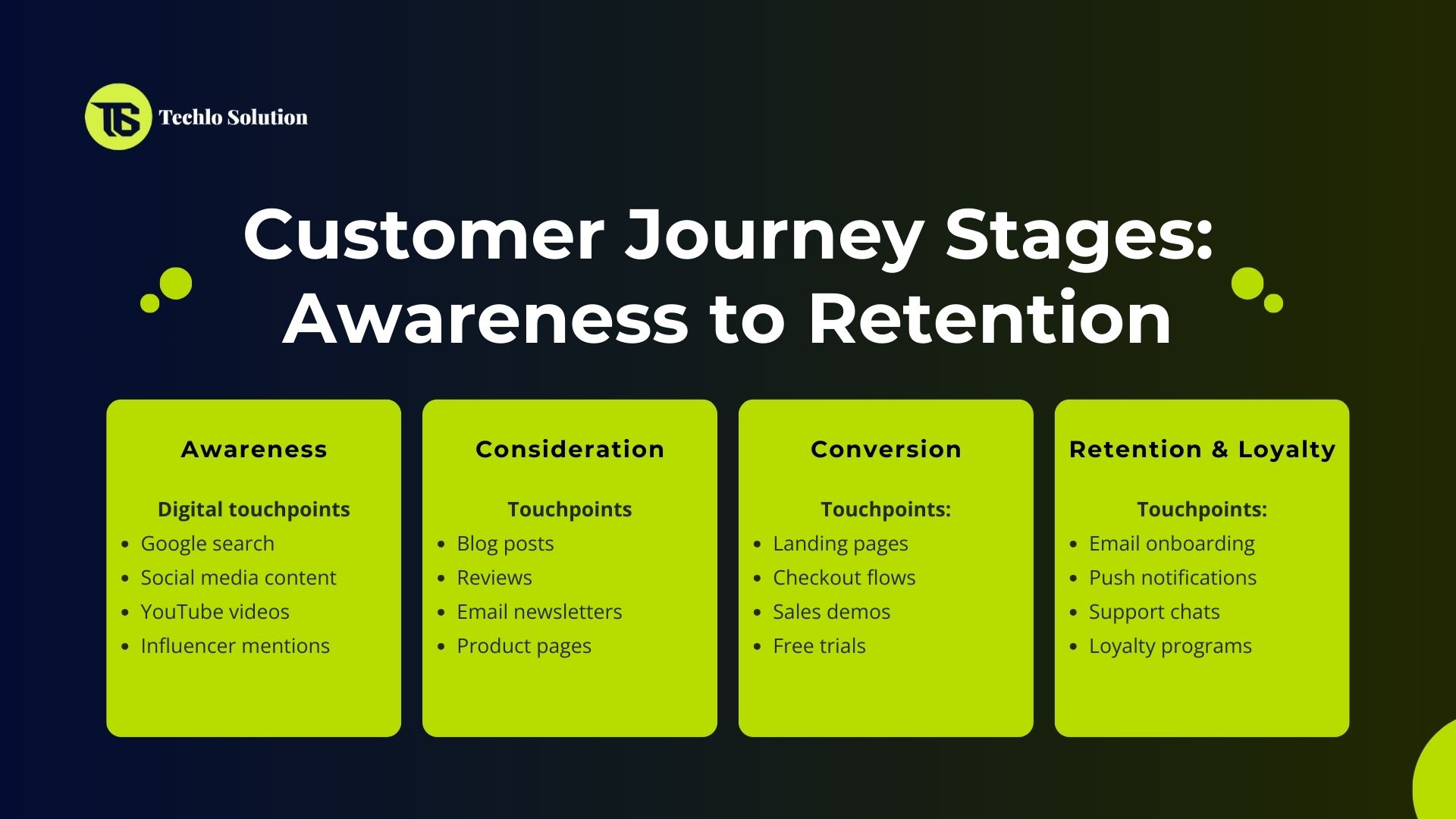
Customer Journey Stages: Awareness to Retention

Although the journey is nonlinear, it still includes core stages.

1. Awareness

The customer realizes they have a problem or need.

Digital touchpoints:

  • Google search
  • Social media content
  • YouTube videos
  • Influencer mentions

2. Consideration

The customer compares solutions and brands.

Touchpoints:

  • Blog posts
  • Reviews
  • Email newsletters
  • Product pages

3. Conversion

The customer takes action.

Touchpoints:

  • Landing pages
  • Checkout flows
  • Sales demos
  • Free trials

4. Retention & Loyalty

The customer stays engaged after purchase.

Touchpoints:

  • Email onboarding
  • Push notifications
  • Support chats
  • Loyalty programs

Understanding these customer journey stages awareness to retention is the foundation of journey mapping.

Digital Customer Journey Mapping Explained

Digital customer journey mapping is the process of visualizing how users interact with your brand across channels.

Why Journey Mapping Is Critical in 2026

  • Identifies friction points
  • Improves conversion paths
  • Aligns teams around the customer
  • Supports personalization strategies

Simple Journey Map Example

Search → Blog → Email Signup → Product Demo → Purchase → Follow-up Email

This approach helps marketers design a data-driven customer journey strategy.

Omni channel Customer Journey in 2026

The Omni channel customer journey in 2026 goes beyond being “present everywhere.”

It means:

  • Connected data across channels
  • Consistent messaging
  • Seamless transitions

Example (US Retail Brand)

  • The customer sees Instagram ad
  • Searches for the brand on Google
  • Visits website on mobile
  • Buys in-store
  • Receives email follow-up

Disconnected channels break trust. Connected journeys build loyalty.

Digital Touchpoints Across the Customer Journey

In 2026, brands manage dozens of digital touch points across the customer journey.

Key touch points include:

  • Search engines
  • Social platforms
  • Websites & apps
  • Email
  • Chabot’s
  • CRM systems

Marketers must optimize each touch point, not just ads.

AI-Driven Customer Journey: The New Standard

AI-driven customer journey strategies are no longer optional.

AI helps marketers:

  • Predict customer behavior
  • Personalize content in real time
  • Automate messaging
  • Optimize conversion paths

AI Personalization in Marketing

Examples:

  • Personalized homepage content
  • Product recommendations
  • Predictive email timing
  • Dynamic ad creatives

AI enables real-time customer engagement at scale.

B2C vs B2B Digital Customer Journey Frameworks

B2C Digital Customer Journey Framework

  • Shorter cycles
  • Emotion-driven decisions
  • Strong role of social media
  • Mobile-first experiences

B2B Digital Customer Journey Mapping

  • Longer sales cycles
  • Multiple decision-makers
  • Content-heavy consideration stage
  • CRM-driven attribution

Both require a tailored customer journey strategy for digital marketing.

Data, Privacy, and Customer Journeys in the USA

With privacy regulations and cookie limitations, first-party data and customer journeys are essential.

Privacy-First Customer Data Strategy

  • Use consent-based data
  • Rely on CRM and email lists
  • Leverage server-side tracking
  • Focus on trust and transparency

This is especially important for US-based marketers.

Measuring the Digital Customer Journey ROI

You can’t improve what you don’t measure.

Key Metrics:

  • Conversion rates
  • Drop-off points
  • Time to conversion
  • Customer lifetime value
  • Attribution paths

Modern marketing attribution models help identify which channels truly drive value.

Conversion Path Optimization Tips (2026 Ready)

To improve results:

  • Reduce steps to conversion
  • Improve page speed
  • Use clear CTAs
  • Align messaging across channels
  • Test continuously

These tactics improve measuring customer journey ROI and overall performance.

Customer Journey Trends in 2026

Important customer journey trends for 2026 include:

  • Predictive customer journey modeling
  • AI-powered personalization
  • Automation across lifecycle stages
  • Experience-focused metrics
  • Cross-channel analytics

Staying updated is key for growth marketers.

My Real-World Experience Learning Digital Marketing

When I first started learning digital marketing, understanding the digital customer journey felt confusing. Terms like “funnels,” “touch points,” and “attribution” sounded complex. At the beginning, I made the mistake of focusing only on traffic, SEO keywords, blog posts, and rankings without thinking about what happens after users arrive.

Over time, I realized that traffic alone does not create results. When I started analyzing how users from the United States moved from search results to content and then to engagement and conversion, everything became clearer. Tools like Google Search Console helped me see real user behavior, not assumptions. At one stage, I focused too much on optimizing individual pages instead of improving the entire journey. Once I shifted my mindset to helping users at each stage from awareness to retention, my content performance and engagement improved. For beginners and marketers alike, understanding the customer journey is not about shortcuts; it’s about patience, learning from data, and designing experiences that genuinely help people.

Common Mistakes Marketers Make with Customer Journeys

Avoid these pitfalls:

  • Focusing on single channels
  • Ignoring retention
  • Over-automation without strategy
  • Poor data integration
  • Measuring vanity metrics only

A strong end-to-end digital customer journey avoids these errors.

Conclusion: The Digital Customer Journey Is the Strategy

In 2026, marketing success is not about channels—it’s about experiences.

Marketers who understand the digital customer journey in 2026 can:

  • Personalize at scale
  • Improve ROI
  • Build long-term loyalty
  • Compete in crowded US markets

Call-to-Action (CTA)

  • Audit your current customer journey
  • Map key digital touch points
  • Optimize one stage at a time using data

The future of marketing belongs to those who design journeys, not just campaigns.


FAQs – Digital Customer Journey (SEO)

What is the digital customer journey in 2026?

It’s the full, Omni channel experience a customer has with a brand, powered by data and AI.

Why is customer journey mapping important?

It helps identify gaps, improve conversions, and create better experiences.

How does AI impact the customer journey?

AI enables personalization, prediction, and automation across all stages.

Is the customer journey the same for B2B and B2C?

No. B2B journeys are longer and more complex than B2C.

How can marketers measure journey performance?

Through analytics, attribution models, and lifecycle metrics.

✍️ Author Bio (E-E-A-T)

Written by Techlo Solution
Digital Marketing Learner & SEO Practitioner
Helping beginners, students, and marketers understand online marketing in simple words.
A Step-by-Step Guide for Startups in the United States Starting a business in 2026 is exciting but also challenging. Startups today face intense competition, limited budgets, and fast-changing digital platforms. Many founders know they “need digital marketing,” but they often feel overwhelmed by complex strategies, tools, and jargon.

Creating a Simple Digital Marketing Strategy in 2026

A Step-by-Step Guide for Startups in the United States

Starting a business in 2026 is exciting but also challenging. Startups today face intense competition, limited budgets, and fast-changing digital platforms. Many founders know they “need digital marketing,” but they often feel overwhelmed by complex strategies, tools, and jargon.

The good news? You don’t need a complicated plan to grow.

This guide will show you how to create a simple digital marketing strategy for startups, one that is practical, affordable, and easy to execute, even if you are not a marketer.

This article is written in simple English, with real-world examples, actionable steps, and USA-focused insights, making it ideal for founders, early teams, and non-marketers.


Why Startups Need a Simple Digital Marketing Strategy in 2026

Most startups fail not because the product is bad, but because people don’t know about it.

In 2026:

  • Customers discover brands online first
  • Paid ads are more competitive
  • Organic trust matters more than hype
  • Data-driven decisions outperform guesses

A simple digital marketing strategy for startups helps you:

  • Focus on the right channels
  • Avoid budget waste
  • Acquire customers consistently
  • Scale step by step

Simplicity creates clarity, and clarity drives execution.

What Is a Simple Digital Marketing Strategy?

A simple strategy is not “doing everything.”
It is about doing the right few things well.

A digital marketing strategy for startups answers four questions:

  1. Who is your target customer?
  2. What problem do you solve?
  3. Which digital channels will you use?
  4. How will you measure success?

If you can answer these clearly, you already have the foundation.

Step 1: Define Your Target Audience (Critical First Step)

Many early-stage startups make the mistake of targeting “everyone.”

This is one of the biggest startup marketing errors.

How to Define Your Audience

Focus on:

  • Location (USA, state, or city)
  • Age group
  • Job role or lifestyle
  • Main pain point
  • Buying intent

Example:
Instead of “small businesses,” target
“US-based local service businesses with 1–10 employees.”

Clear targeting improves:

  • Customer acquisition strategy for startups
  • Ad performance
  • Content relevance

Step 2: Clarify Your Value Proposition

Before marketing, ask:

Why should someone choose you?

Your value proposition should be:

  • Clear
  • Specific
  • Customer-focused

Bad example:
“We offer the best digital solutions.”

Good example:
“We help bootstrapped US startups get their first 1,000 users using SEO and content marketing.”

This supports startup branding and positioning from day one.

Step 3: Choose the Right Digital Channels (Not All of Them)

One major mistake startups make is trying every channel at once.

A digital marketing framework for startups should focus on 1–2 channels initially.

Best Digital Channels for Startups in 2026

Choose based on your audience:

  • SEO strategy for startupslong-term, high trust
  • Content marketing for startupsauthority and education
  • Social media marketing for startupsawareness and engagement
  • Performance marketing for startupsfast testing and traction

You can always expand later.

Step 4: Build a Simple Startup Digital Marketing Plan

Your startup digital marketing plan does not need to be complex.

A Simple Plan Looks Like This:

  • Goal: Get 500 website visitors/month
  • Channel: SEO + content
  • Content: 2 blog posts per month
  • Measurement: Google Search Console

This is a beginner digital marketing strategy that works.

Step 5: Content Marketing as a Growth Foundation

Content is one of the most powerful low-budget digital marketing tactics.

Why?

  • It builds trust
  • It supports SEO
  • It educates customers
  • It compounds over time

Content Ideas for Startups

  • “How-to” guides
  • Problem-solving blogs
  • Case studies
  • Startup journey posts
  • Local USA-focused content

Content fuels your go-to-market strategy for startups.

Step 6: SEO Basics for Startups (Keep It Simple)

You don’t need advanced SEO tools to start.

Focus on:

  • One main keyword per page
  • Helpful content
  • Fast-loading website
  • Mobile-friendly design

Target long-tail keywords like:

  • “digital marketing plan for small startups”
  • “online marketing strategy for new businesses”

This supports early-stage startup marketing without heavy costs.

Step 7: Social Media Marketing Without Burnout

Social media is useful but only when done intentionally.

Simple Social Strategy

  • Pick one platform
  • Post consistently (2–3 times/week)
  • Share helpful, honest content
  • Engage with comments

Avoid chasing trends blindly.
Social media should support, not distract from, growth.

Step 8: Affordable Paid Marketing (Optional but Strategic)

If you have a small budget, paid ads can help test ideas fast.

Use ads for:

  • Lead magnets
  • Email signups
  • Early traction
  • Retargeting visitors

This fits well with bootstrapped startup marketing when budgets are controlled.

Step 9: Build a Simple Marketing Funnel

A marketing funnel for startups keeps your strategy focused.

Simple Funnel:

  • Awareness: Blog posts, social media
  • Interest: Email signup, free guide
  • Conversion: Demo, trial, purchase
  • Retention: Email updates, value content

Funnels turn traffic into customers.

Step 10: Measure What Matters (Avoid Vanity Metrics)

Many startups track likes but ignore revenue signals.

Measure:

  • Website traffic
  • Email signups
  • Leads
  • Conversion rates
  • Cost per acquisition

This helps in measuring digital marketing ROI properly.

Use tools like:

  • Google Analytics
  • Google Search Console
  • Simple spreadsheets

Step 11: Local SEO for US-Based Startups

If your startup serves a specific region, local SEO is powerful.

Optimize:

  • Google Business Profile
  • Local keywords (city/state)
  • Customer reviews
  • Location pages

This is essential for US-based service startups.

Current Digital Marketing Trends for Startups in 2026

Stay aware, but don’t chase everything.

Important trends:

  • AI-assisted content creation
  • Search intent optimization
  • Short-form educational video
  • Privacy-first marketing
  • Automation tools for startups

Use trends to support your strategy, not replace it.

My Real-World Experience Learning Digital Marketing

When I first started learning digital marketing, terms like SEO, Google Ads, and content marketing felt overwhelming. I honestly thought this field was only for tech experts, but with consistent practice, I realized that beginners and startup founders can learn digital marketing step by step.

In the beginning, I made the mistake of trying to learn everything at once, which only created confusion. Once I focused on one skill at a time, especially SEO basics, my understanding improved significantly. While learning SEO, I discovered that simply adding keywords is not enough.

When I started creating content to genuinely help users, I noticed organic traffic from the United States slowly growing. Many startup founders expect quick results, but based on my experience, focusing on learning, testing, and real practice always leads to better long-term growth.

Using tools like Google Search Console helped me understand what people are actually searching for. At first, it felt confusing, but regular use made it easier to analyze real user behavior. At one point, I focused too much on writing for search engines instead of real readers. Once I shifted my approach to helping people first, content performance improved.

If you are building a startup, digital marketing can be a realistic and scalable growth engine as long as you stay patient and trust simple strategies over shortcuts.

Common Mistakes Startups Should Avoid

Avoid these early:

  • No clear goals
  • Trying all channels at once
  • Ignoring SEO basics
  • Not tracking performance
  • Copying competitors blindly

Simple strategies work when executed consistently.

Conclusion: Simplicity Is the Real Growth Strategy

In 2026, startups don’t win by doing more—they win by doing what matters.

A simple digital marketing strategy for startups helps you:

  • Focus on execution
  • Save time and money
  • Learn faster
  • Build sustainable growth

Call-to-Action (CTA)

  • Start with one channel this month
  • Create helpful content for your audience
  • Measure results and improve step by step

Digital marketing success is built through clarity, consistency, and patience.

FAQs – Digital Marketing Strategy for Startups (SEO)

What is a simple digital marketing strategy for startups?

It is a focused plan using 1–2 channels with clear goals and tracking.

Is digital marketing expensive for startups?

No. Many strategies like SEO and content marketing are low-cost.

How long does it take to see results?

SEO and content take 3–6 months; ads can be faster.

Which channel is best for early-stage startups?

SEO, content marketing, and one social platform are ideal.

Do founders need marketing experience?

No, with simple steps and tools, anyone can start.

✍️ Author Bio (E-E-A-T)
Written by Techlo Solution
Digital Marketing Learner & SEO Practitioner
Helping beginners, students, and startups understand online marketing in simple words.
Digital marketing in 2026 offers endless opportunities but also many hidden traps. New marketers often jump in with excitement, tools, and big goals, only to feel confused when results don’t come.

Common Digital Marketing Mistakes to Avoid in 2026

A Beginner-Friendly Guide for New Marketers in the United States

Digital marketing in 2026 offers endless opportunities but also many hidden traps. New marketers often jump in with excitement, tools, and big goals, only to feel confused when results don’t come.

The truth is simple: most failures come from common digital marketing mistakes, not from lack of effort.

If you are a student, beginner, or new marketer in the United States, this guide will help you understand the digital marketing mistakes to avoid in 2026, why they happen, and how to fix them using proven digital marketing best practices.

This article is written in simple English, with real-world examples, actionable tips, and USA-focused insights.

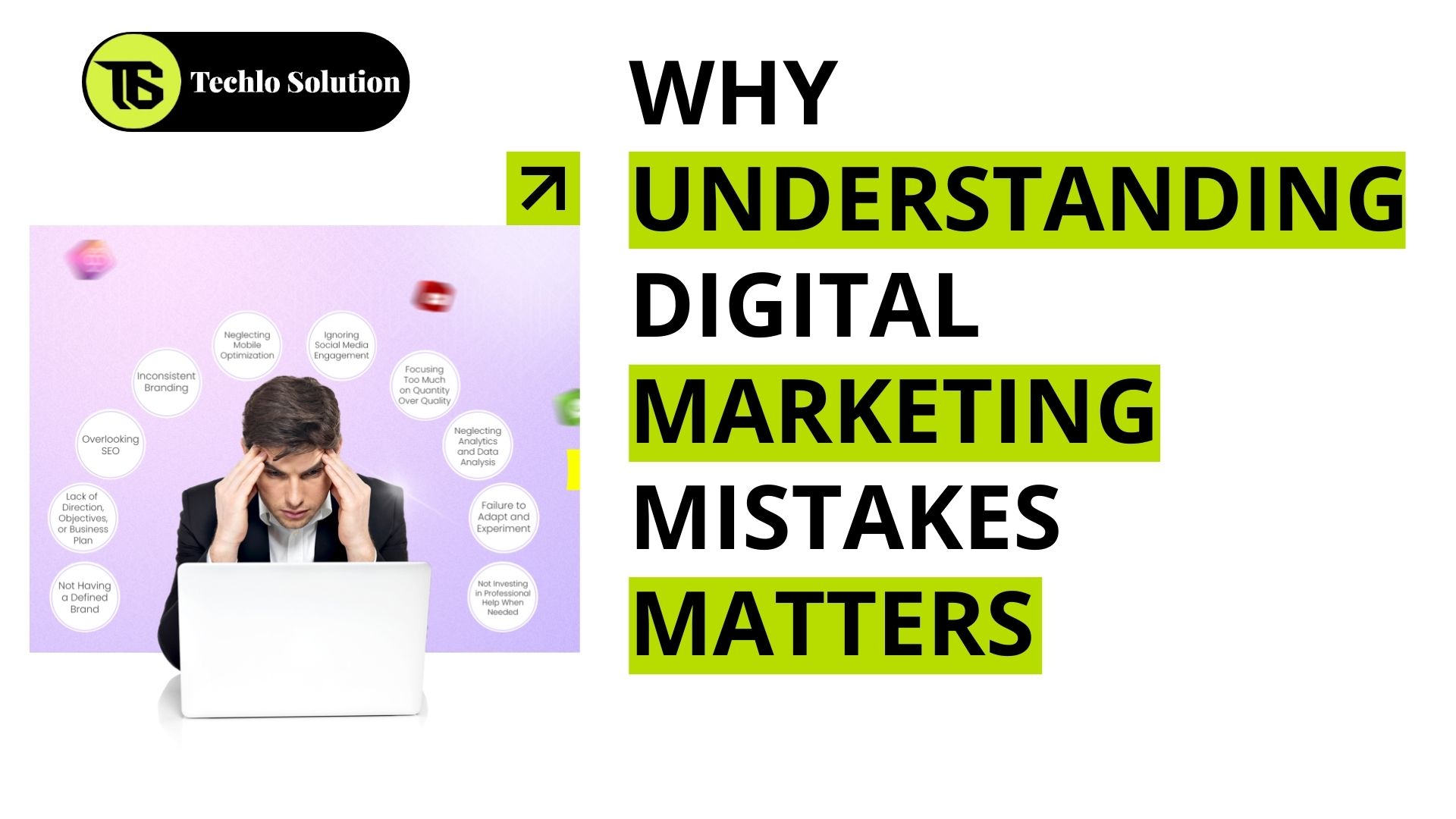
Why Understanding Digital Marketing Mistakes Matters in 2026

Digital marketing is changing fast:

  • AI tools are everywhere
  • Competition is higher than ever
  • Ad costs are rising
  • User attention is shorter

For beginners, avoiding mistakes is often more important than learning advanced strategies.

One wrong move can lead to budget waste in digital marketing, low conversions, and lost confidence.

Let’s break down the most common digital marketing mistakes new marketers make and how to avoid them.

1. No Clear Marketing Goals (The #1 Beginner Mistake)

One of the biggest digital marketing mistakes to avoid is starting without clear goals.

Many beginners say:

  • “I want more traffic.”
  • “I want to grow my brand.”

But they don’t define how much, from where, or by when.

Why This Is a Problem

  • You can’t measure success
  • You waste time and money
  • You don’t know what to improve

How to Fix It

Set SMART goals:

  • Specific
  • Measurable
  • Achievable
  • Relevant
  • Time-bound

Example (USA-based):
“Get 500 website visitors from Google in 60 days using SEO.”

This removes confusion and guides your strategy.

2. Ignoring Data and Analytics

Many digital marketing errors for beginners happen because they ignore data.

They post content, run ads, and hope for results without tracking anything.

Common Analytics Mistakes

  • Not using Google Analytics
  • Not checking conversion rates
  • Ignoring bounce rate
  • No campaign tracking

Why This Hurts

  • You repeat the same mistakes
  • You don’t know what’s working
  • Your growth slows down

Actionable Tip

Use free tools:

  • Google Analytics
  • Google Search Console
  • Meta Ads Manager

Data helps you optimize, not guess.

3. Wrong Keyword Targeting (SEO Mistake)

Wrong keyword targeting is one of the most common SEO mistakes beginners make.

New marketers often target:

  • Very broad keywords
  • High-competition terms
  • Irrelevant keywords

Example

Targeting “digital marketing” instead of
“digital marketing mistakes for beginners in USA”

How to Fix It

  • Use long-tail keywords
  • Focus on search intent
  • Target beginner-friendly queries
  • This improves rankings and traffic quality.

4. Ignoring Local SEO (Big Mistake in the USA)

Many beginners forget local SEO, especially in the United States.

If you’re promoting:

  • A service
  • A local brand
  • A small business

Local SEO is critical.

Local SEO Mistakes

  • No Google Business Profile
  • No location-based keywords
  • No local citations
  • Ignoring reviews

Fix

Optimize for:

  • “Near me” searches
  • City/state keywords
  • Google Maps visibility

Local SEO brings high-intent traffic.

5. Inconsistent Branding Across Platforms

Inconsistent branding online confuses users and kills trust.

Common branding mistakes:

  • Different logos
  • Different brand tone
    • Random color schemes
    • Mixed messaging

      Why It Matters

      Brand consistency:

      • Builds trust
      • Improves recognition
      • Increases conversions

      Fix

      Create a simple brand guide:

      • Logo usage
      • Brand colors
      • Tone of voice
      • Messaging style

      Consistency = credibility.

      6. Social Media Marketing Without a Strategy

      Social media marketing mistakes are very common among beginners.

      Posting daily without a plan is not a strategy.

      Common Errors

      • Posting random content
      • Chasing every trend
      • No content calendar
      • No audience research

      What to Do Instead

      • Choose 1–2 platforms
      • Know your target audience
      • Create valuable content
      • Track engagement

        Strategy

        Social media marketing mistakes are very common among beginners.

        Posting daily without a plan is not a strategy.

        Common Errors

        • Posting random content
        • Chasing every trend
        • No content calendar
        • No audience research

        What to Do Instead

        • Choose 1–2 platforms
        • Know your target audience
        • Create valuable content
        • Track engagement
  • 7. Content Marketing Without Value

    Content marketing mistakes happen when content is created only for SEO, not users.

    Examples:

    • Keyword stuffing
    • Thin content
    • Rewritten generic posts
    • No real insight

    Why This Fails in 2026

    Google prioritizes:

    • Helpful content
    • Real experience
    • User satisfaction
  • Fix

    Ask before publishing:

    • Does this solve a problem?
    • Is this beginner-friendly?
    • Is this better than competitors?

    Helpful content wins.

    8. Email Marketing Mistakes Beginners Make

    Email marketing mistakes can destroy trust fast.

    Common problems:

    • Sending too many emails
    • No segmentation
    • No personalization
    • Weak subject lines
    • How to Improve

      • Segment your email list
      • Personalize subject lines
      • Focus on value, not selling
      • Test and optimize

      Email marketing still delivers high ROI when done right.

  • 9. Paid Advertising Without Testing

    Paid advertising mistakes cost beginners the most money.

    Many new marketers:

    • Launch ads without testing
    • Target broad audiences
    • Ignore ad creatives
    • Skip retargeting

    Result

  • Low ROI
  • Budget waste
  • Poor conversions

Best Practice

  • Start with small budgets
  • Test multiple creatives
  • Use clear CTAs
  • Track conversions

Ads need data—not guesswork.

10. Poor Audience Targeting

Poor audience targeting is one of the most expensive online marketing mistakes.

If you market to “everyone,” you connect with no one.

How to Fix

Define your audience:

  • Age
  • Location (USA-based)
  • Interests
  • Problems
  • Buying intent

Better targeting = higher conversions.

11. Ignoring Conversion Optimization

Many beginners focus only on traffic but ignore low conversion rate issues.

Problems include:

  • Slow websites
  • Poor landing pages
  • Confusing CTAs
  • Fix

    Optimize:

    • Page speed
    • Mobile experience
    • Clear CTAs
    • Social proof

    Traffic without conversions is wasted effort.

    12. No Clear Marketing Strategy

    Marketing strategy mistakes happen when marketers try everything at once.

    SEO, ads, email, and social media without focus.

    Why This Fails

    • Burnout
    • Inconsistent results
    • No mastery
  • Smart Approach

    • Start with one channel
    • Learn it well
    • Measure results
    • Scale slowly

    Focus creates growth.

    13. Not Following Digital Marketing Best Practices

    In 2026, best practices matter more than hacks.

    Ignoring:

    • User experience
      • Privacy policies
      • Transparency
      • Ethical marketing

      Can damage both rankings and trust.

Digital Marketing Trends Beginners Should Know in 2026

To avoid digital marketing pitfalls, stay updated with trends:

  • AI-powered analytics
  • Voice search optimization
  • Short-form video
  • Privacy-first marketing
  • Automation tools

Learning trends helps you stay competitive.

Real Example: Beginner Mistake & Fix

A US-based student marketer ran Facebook ads without tracking.

Result:
$300 spent, zero conversions.

Fix:
Added tracking, narrowed audience, tested creatives.

Outcome:
Leads generated at half the cost.

Mistakes become lessons when corrected early.

My Real-World Experience Learning Digital Marketing

When I first started learning digital marketing, terms like SEO, Google Ads, and content marketing felt overwhelming. I honestly believed that digital marketing was only for large companies with big budgets. Over time, through consistent learning and real practice, I realized that small businesses can grow faster than big brands if digital marketing is used strategically.

Initially, I made the mistake of focusing on too many strategies at once. This created confusion and slow results. Once I narrowed my focus starting with SEO and content marketing, I began to see how helpful, user-focused content drives organic traffic, especially from the United States.

One major lesson I learned was that digital marketing is not about tricks or shortcuts. Many business owners expect instant results, but sustainable growth comes from patience, testing, and continuous improvement. When I started analyzing real search data using tools like Google Search Console, I better understood what customers were actually looking for.

Conclusion: Mistakes Are Costly But Avoidable

Every marketer makes mistakes. But smart marketers learn fast and fix early.

By avoiding these digital marketing mistakes to avoid in 2026, you can:

  • Save money
  • Grow faster
  • Build confidence
  • Deliver better results

Call-to-Action (CTA)

  • Review your current strategy today
  • Fix one mistake at a time
  • Focus on value, data, and consistency

Digital marketing success starts with avoiding common errors.

FAQs – Digital Marketing Mistakes (SEO)

What are the most common digital marketing mistakes?

Lack of strategy, wrong targeting, ignoring data, and poor SEO.

Are digital marketing mistakes common for beginners?

Yes. Most beginners face these issues early.

How can new marketers avoid mistakes?

Start with clear goals, track data, and focus on one channel.

Is SEO difficult for beginners?

No, if you target the right keywords and follow best practices.

Can mistakes hurt long-term growth?

Yes, especially budget waste and poor branding.

✍️ Author Bio (E-E-A-T Fix)
Written by Techlo Solution
Digital Marketing Learner & SEO Practitioner
Helping beginners, students, and small businesses understand online marketing in simple words.
Running a small or medium business in the United States has never been easy, and in 2026, competition is tougher than ever. Customers search online before buying, compare brands on social media, and expect personalized experiences across digital platforms.

Small Business Growth in 2026: Why Digital Marketing Matters

A useful Growth Guide for Small and Medium Businesses (SMBs) in the United States

Running a small or medium business in the United States has never been easy, and in 2026, competition is tougher than ever. Customers search online before buying, compare brands on social media,
and expect personalized experiences across digital platforms.

This is exactly why digital marketing for small businesses is no longer optional. In this in-depth guide, you’ll learn how digital marketing helps small businesses grow, which strategies actually work in 2026, and how SMBs in the USA can compete with bigger brands using cost-effective digital marketing solutions.

This article is written in simple English, beginner-friendly, and formatted for WordPress blogs.

Why Digital Marketing Matters for Small Businesses in 2026

Consumer behavior has shifted permanently toward digital platforms. Today:

  • Customers search on Google before visiting a store
  • Social media influences buying decisions
  • Online reviews impact trust
  • Local searches drive foot traffic

For SMBs, online marketing for small businesses offers something traditional marketing never could:
measurable, affordable, and scalable growth.

What Is Digital Marketing for Small Businesses?

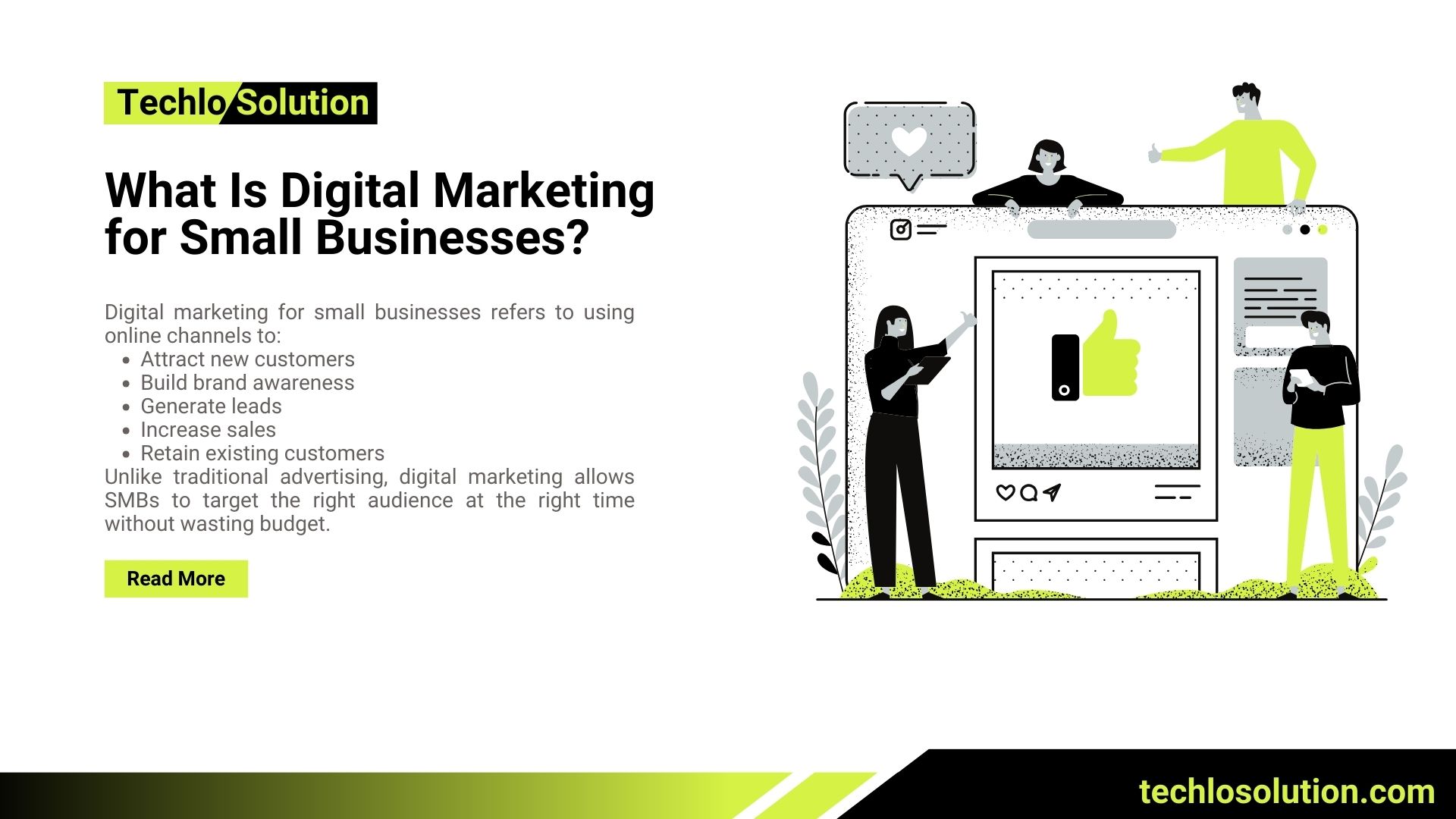
Digital marketing for small businesses refers to using online channels to:

  • Attract new customers
  • Build brand awareness
  • Generate leads
  • Increase sales
  • Retain existing customers

Unlike traditional advertising, digital marketing allows SMBs to target the right audience at the right time without wasting budget.

How Digital Marketing Helps Small Businesses Grow

Let’s break down how digital marketing helps small businesses grow in practical, real-world terms.

1. Increases Online Visibility and Brand Awareness

Most customers won’t buy from a business they can’t find online.

Digital marketing helps SMBs:

  • Appear on Google search results
  • Show up on Google Maps
  • Stay visible on social media
  • Build a consistent online presence

Improving brand visibility online is often the first step toward sustainable growth.

Cost-Effective Digital Marketing for SMBs

One of the biggest benefits of digital marketing for SMBs is affordability.

Why Digital Marketing Is Budget-Friendly

  • No minimum budget like TV or print ads
  • Pay only for results (PPC, social ads)
  • Organic traffic through SEO and content
  • Easy to test and optimize campaigns

This makes cost-effective digital marketing for SMBs possible—even with limited resources.

Customer Acquisition Through Digital Marketing

Digital marketing gives small businesses powerful tools for customer acquisition.

Key Customer Acquisition Channels:

  • Google Search (SEO & PPC)
  • Social media marketing
  • Email campaigns
  • Content marketing
  • Paid advertising

Each channel plays a role in attracting, nurturing, and converting leads.

Local SEO for Small Businesses (USA-Focused)

For SMBs in the United States, local SEO is one of the most powerful growth strategies.

What Local SEO Does

Local SEO allows your business to appear when consumers search:

  • “Near me” searches
  • City-based services
  • Local product searches

Example:

“Best coffee shop in Austin, TX”

Optimizing your:

  • Google Business Profile
  • Local keywords
  • Reviews and ratings

can drive real foot traffic and local sales.

Social Media Marketing for Small Businesses

Social media is no longer just for big brands.

Why Social Media Works for SMBs:

  • Builds trust and relationships
  • Promotes offers and events
  • Drives website traffic
  • Supports customer service

Platforms like Instagram, Facebook, LinkedIn, and TikTok are essential for small business digital marketing growth in 2026.

Content Marketing for Small Businesses

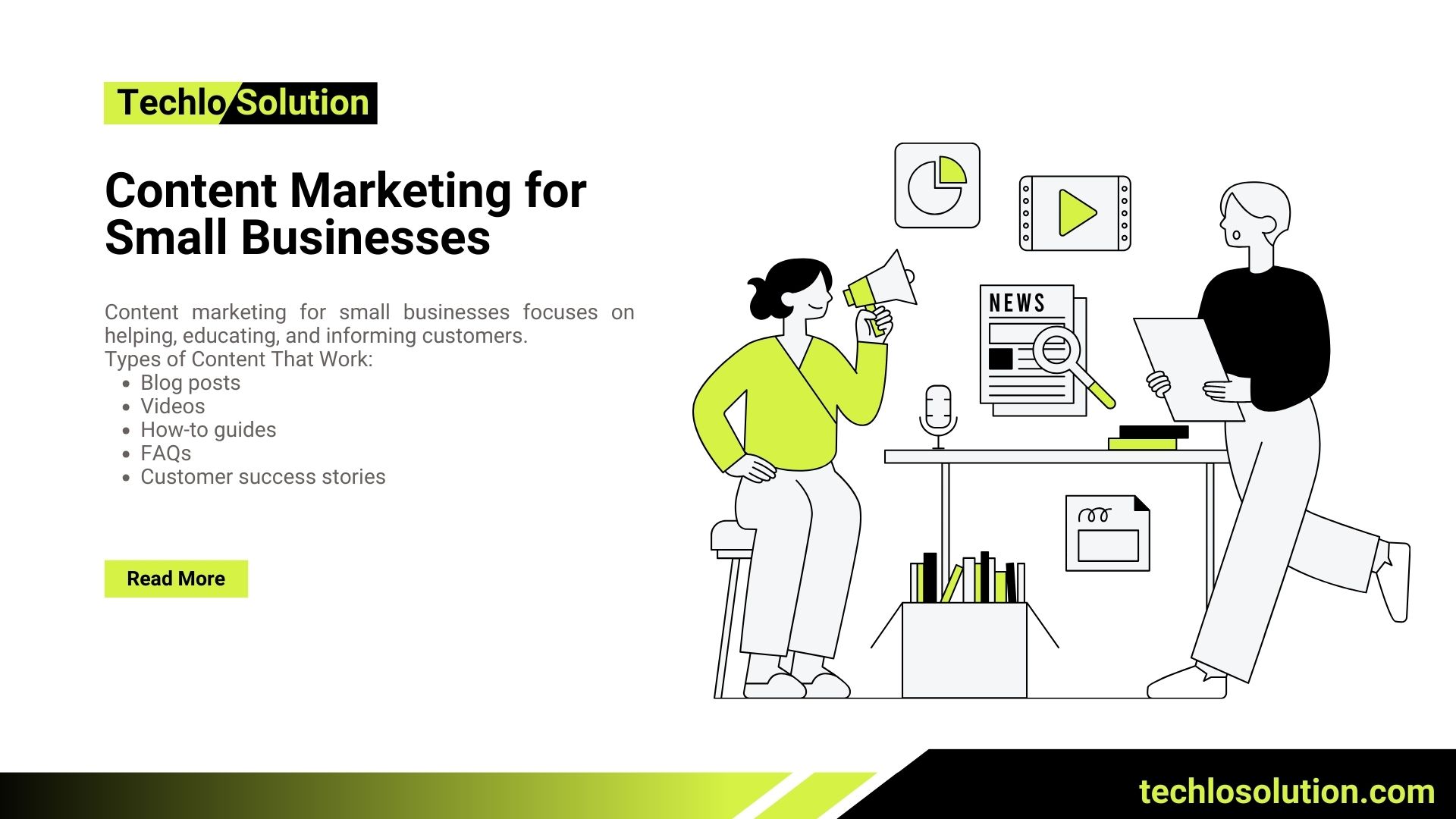
Content marketing for small businesses focuses on helping, educating, and informing customers.

Types of Content That Work:

  • Blog posts
  • Videos
  • How-to guides
  • FAQs
  • Customer success stories

Content builds long-term trust and supports SEO, email, and social media marketing.

Email Marketing for Small Business Growth

Email marketing remains one of the highest ROI digital marketing solutions for small businesses.

Email Marketing Benefits:

  • Low cost
  • Direct communication
  • Personalized messaging
  • Easy automation

Email is ideal for:

  • Promotions
  • Customer retention
  • Upselling
  • Relationship building

Lead Generation for Small Businesses

Digital marketing turns visitors into leads.

Common Lead Generation Methods:

  • Website forms
  • Landing pages
  • Free offers (guides, coupons)
  • Email signups
  • Paid ads

This allows SMBs to build predictable sales pipelines.

Paid Advertising for Small Businesses

Paid ads deliver fast results when used wisely.

Paid Advertising Options:

  • Google Ads
  • Facebook & Instagram Ads
  • YouTube Ads
  • Retargeting campaigns

Paid advertising supports:

  • Quick traffic
  • Seasonal promotions
  • Product launches

Measuring Digital Marketing ROI for SMBs

One major advantage of digital marketing is measurability.

You can track:

  • Website traffic
  • Lead sources
  • Conversion rates
  • Cost per lead
  • Return on investment (ROI)

This makes digital marketing ROI for SMBs clear and actionable.

Digital Marketing Tools for Small Businesses

You don’t need expensive software to succeed.

Beginner-Friendly Tools:

  • Google Analytics
  • Google Search Console
  • Canva
  • Mailchimp
  • Meta Ads Manager

These tools help SMBs make data-driven decisions.


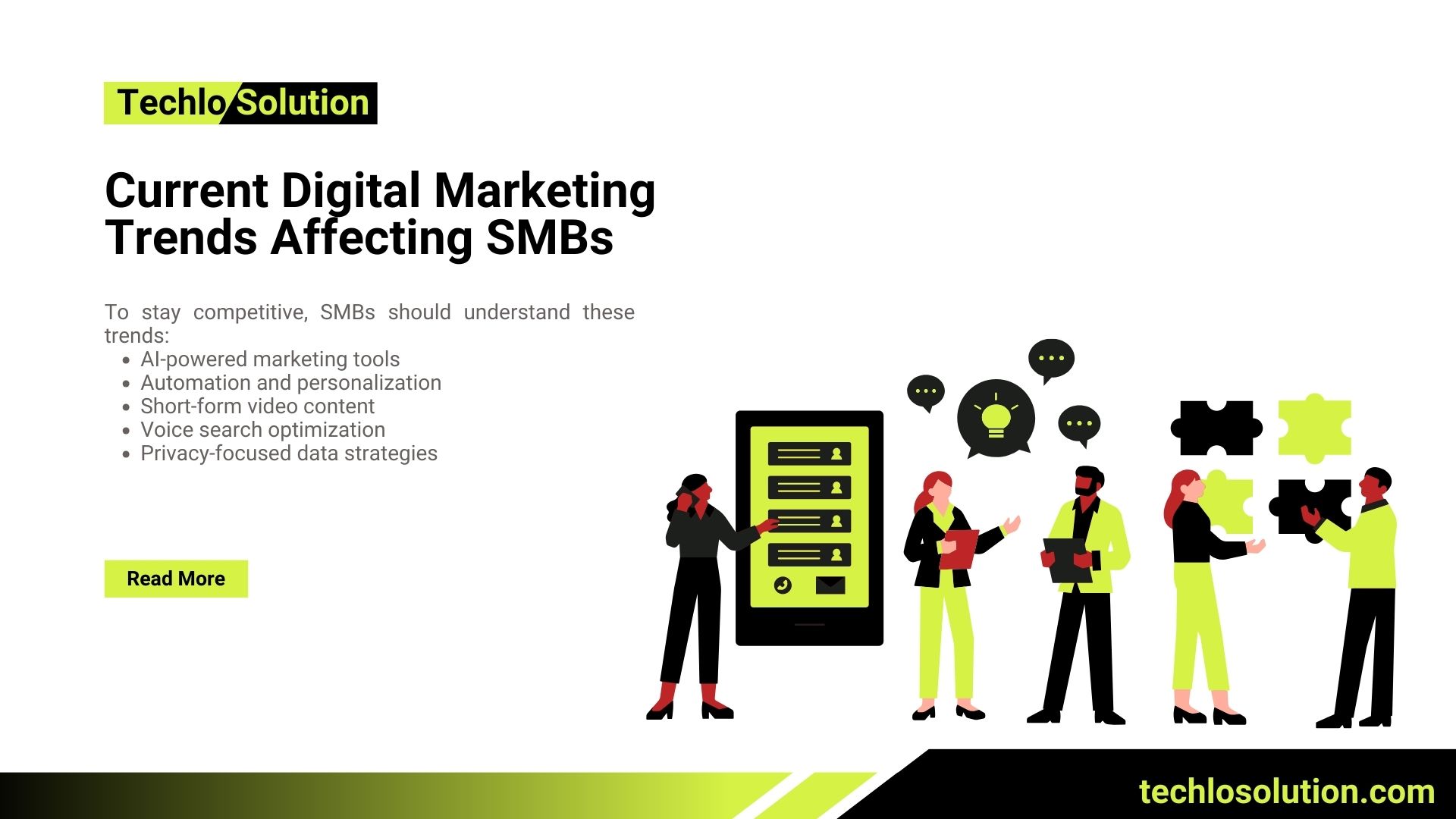
Current Digital Marketing Trends Affecting SMBs in 2026

To stay competitive, SMBs should understand these trends:

  • AI-powered marketing tools
  • Automation and personalization
  • Short-form video content
  • Voice search optimization
  • Privacy-focused data strategies

Digital marketing is evolving but fundamentals still matter.

My Real-World Experience Learning Digital Marketing (Adapted for SMBs)

When I first started learning digital marketing, terms like SEO, Google Ads, and content marketing felt overwhelming. I honestly believed that digital marketing was only for large companies with big budgets. Over time, through consistent learning and real practice, I realized that small businesses can

grow faster than big brands if digital marketing is used strategically.

Initially, I made the mistake of focusing on too many strategies at once. This created confusion and slow results. Once I narrowed my focus starting with SEO and content marketing, I began to see how helpful, user-focused content drives organic traffic, especially from the United States.

One major lesson I learned was that digital marketing is not about tricks or shortcuts. Many business owners expect instant results, but sustainable growth comes from patience, testing, and continuous improvement. When I started analyzing real search data using tools like Google Search Console, I better understood what customers were actually looking for.

At one stage, I focused too much on pleasing algorithms instead of real people. Once I shifted my mindset to helping users first, engagement improved naturally. For SMB owners, this same principle applies: serve your audience genuinely, and growth will follow.

Digital marketing is not just a strategy; it’s a long-term growth system for small businesses willing to learn and adapt.

Conclusion: Digital Marketing Is a Growth Engine for SMBs

In 2026, digital marketing for small businesses is no longer optional, it is the foundation of sustainable growth.

With the right strategy, SMBs in the USA can:

  • Compete with larger brands
  • Reach local and national audiences
  • Increase sales and leads
  • Build strong customer relationships

Call-to-Action (CTA)

  • Start with one digital marketing strategy today
  • Focus on helping your customers first
  • Track results and improve consistently

If you want long-term success, digital marketing is your most powerful growth tool.

FAQs – Digital Marketing for Small Businesses (SEO)

How does digital marketing help small businesses grow?

It increases visibility, attracts customers, generates leads, and improves sales using cost-effective online channels.

Is digital marketing affordable for small businesses?

Yes. Many digital marketing strategies work well with small budgets.

Which digital marketing strategy is best for SMBs?

SEO, local SEO, social media, and email marketing are great starting points.

How long does it take to see results?

Paid ads show faster results, while SEO and content marketing take time but deliver long-term growth.

Can small businesses handle digital marketing themselves?

Yes, with basic tools and learning, many SMBs successfully manage digital marketing in-house.

✍️ Author Bio (E-E-A-T Fix)
Written by Techlo Solution
Digital Marketing Learner & SEO Practitioner Helping beginners, students, and small businesses understand online marketing in simple words.
A Complete Beginner’s Guide for Students in the United States If you are a student in the United States and planning a career in digital marketing, one question comes up again and again.

Digital Marketing Channels Explained in2026


A Complete Beginner’s Guide for Students in the United States

If you are a student in the United States planning a career in digital marketing, one question comes up repeatedly:
“What are digital marketing channels, and which ones should I learn in 2026?”

With new platforms, AI tools, and changing user behavior, understanding digital marketing channels is more important than ever. This guide explains online marketing channels step by step, using simple English, real examples, and student-friendly explanations.

Whether you want a job, a freelance career, or to grow a startup, this article will help you understand how digital marketing channels work in 2026.


What Are Digital Marketing Channels?

Digital marketing channels are the online platforms and methods businesses use to reach, attract, engage, and convert customers.

In simple words:

Digital marketing channels are the different ways brands connect with people online.

These channels work together inside a marketing funnel, guiding users from awareness to conversion.

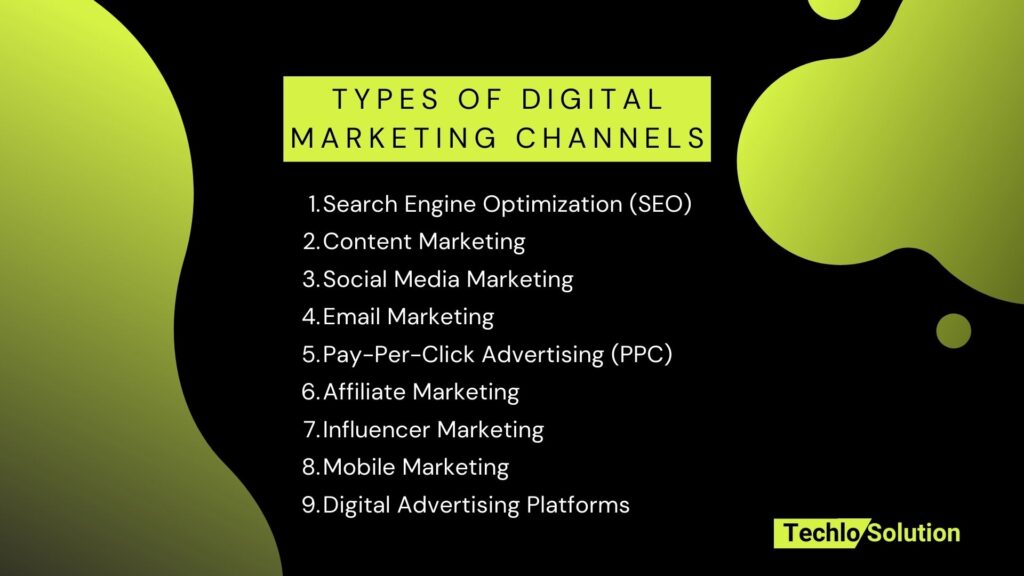
Types of Digital Marketing Channels (Overview)

In 2026, the main digital marketing channels are:

  • Search Engine Optimization (SEO)

  • Content Marketing

  • Social Media Marketing

  • Email Marketing

  • Pay-Per-Click Advertising (PPC)

  • Affiliate Marketing

  • Influencer Marketing

  • Mobile Marketing

  • Digital Advertising Platforms

Each channel has a different purpose—and students should understand how and when to use them.

How Digital Marketing Channels Work

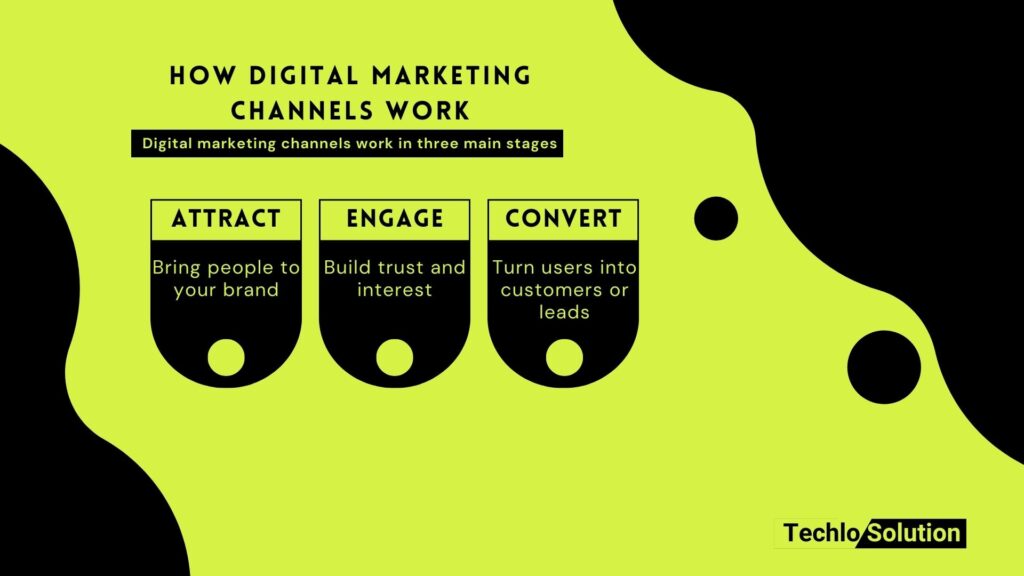
Digital marketing channels generally work in three main stages:

  1. Attract – Bring people to your brand

  2. Engage – Build trust and interest

  3. Convert – Turn users into customers or leads

Some channels are organic, while others are paid.


Organic vs. Paid Digital Channels

Organic Digital Marketing Channels

  • SEO

  • Content marketing

  • Organic social media

  • Email (non-paid lists)

Benefits of organic channels:

  • Take time but build long-term growth

  • Cost-effective

  • Help build authority

Paid Digital Marketing Channels

  • Google Ads

  • Social media ads

  • Display advertising

  • Influencer sponsorships

Benefits of paid channels:

  • Deliver faster results

  • Require a budget

  • Easy to scale

✅ In 2026, successful marketers combine both organic and paid channels.


1. Search Engine Optimization (SEO)

What SEO Does:
SEO helps websites rank higher on Google when people search.

Example:
A student searches: “Best digital marketing courses in the USA.”
SEO ensures the best content appears on page one.

Why SEO Matters in 2026:

  • Over 90% of online experiences start with a search

  • Local searches drive real-world action

  • SEO brings free, long-term traffic

Takeaway: SEO is a must-learn skill for students.


2. Content Marketing Channels

Content marketing focuses on creating helpful content.

Common content channels:

  • Blogs

  • YouTube

  • Podcasts

  • Guides & ebooks

  • Case studies

Why it matters: Builds trust and authority, especially for beginners and startups.

Student Example:
A student creates a blog explaining digital marketing channels and gets internship offers.


3. Social Media Marketing

Social media is one of the most powerful marketing channels in 2026.

Popular platforms:

  • Instagram

  • TikTok

  • LinkedIn

  • Facebook

  • X (Twitter)

Why Social Media Matters:

  • Builds personal brands

  • Drives engagement

  • Ideal for students & startups

  • Supports influencer marketing

Social media marketing is perfect for beginners.


4. Email Marketing Basics

Email marketing remains one of the most profitable channels.

Uses:

  • Newsletters

  • Course updates

  • Promotions

  • Educational emails

Why it works:

  • Direct communication

  • Personalization & automation

  • Low cost

Students learn customer retention and funnel-building through email marketing.


5. Pay-Per-Click Advertising (PPC)

In PPC advertising, you only pay when someone clicks your ad.

Common platforms:

  • Google Ads

  • YouTube Ads

  • Facebook & Instagram Ads

Best for:

  • Fast traffic

  • Product launches

  • Testing ideas

Understanding PPC is essential for performance marketing careers.


6. Affiliate Marketing

Affiliate marketing lets you earn commissions for promoting products.

How it works:

  1. Promote a product link

  2. User buys → you earn a commission

Popular among bloggers, YouTubers, and students seeking passive income.


7. Influencer Marketing

Influencer marketing uses trusted creators to promote brands.

Platforms:

  • Instagram

  • TikTok

  • YouTube

2026 Trend: Micro-influencers perform better than celebrities.
Students can become influencers by building niche audiences.


8. Mobile Marketing

Mobile marketing targets users on smartphones.

Includes:

  • SMS marketing

  • Push notifications

  • Mobile apps

  • Location-based ads

Since most US users browse on mobile, this channel is growing fast.


9. Digital Advertising Methods (Display & Video)

Digital advertising goes beyond search.

Examples:

  • Banner ads

  • YouTube video ads

  • Retargeting ads

  • Native ads

These methods increase brand awareness and conversions.


Real-World Examples

  • Amazon → Email + PPC + SEO

  • Nike → Social media + Influencer marketing

  • Local US restaurant → Google Maps + Instagram

  • Students → LinkedIn + personal blogs

Channels often work together, not in isolation.


Best Digital Marketing Channels for Students in 2026

Start with:

  1. SEO (fundamentals)

  2. Content marketing

  3. Social media marketing

  4. Email marketing basics

  5. Analytics tools

Benefits:

  • Internships

  • Entry-level jobs

  • Freelance work


Digital Marketing Channels for Startups

Startups favor digital channels because they are:

  • Affordable

  • Scalable

  • Measurable

Best channels for startups:

  • SEO

  • Content marketing

  • Social media

  • PPC (small budgets)


Beginner-Friendly Digital Marketing Tools

Tools make learning channels easier:

  • Google Analytics

  • Google Search Console

  • Canva

  • Mailchimp

  • Meta Ads Manager

These are widely used in US companies.


Digital Marketing Trends in 2026

Key trends students should know:

  • AI-powered marketing tools

  • Short-form video dominance

  • Voice search optimization

  • Personalization & automation

  • Data privacy awareness

Channels are evolving, but fundamentals remain the same.


How to Choose the Right Channel

Ask yourself:

  • What is my goal?

  • Who is my audience?

  • What is my budget?

  • Organic or paid?

There is no “one best channel.” Success comes from a clear strategy.


Conclusion: Master Digital Marketing Channels Step by Step

Understanding digital marketing channels is the foundation of a successful career in 2026.

For students:

  • Gain job-ready skills

  • Build career flexibility

  • Get real-world experience

  • Access future-proof opportunities

FAQs – Digital Marketing Channels

Q1: What are digital marketing channels?

They are online platforms and methods used to promote brands and reach customers.

Q2: Which channel is best for beginners?

SEO, content marketing, and social media are the best starting points.

Q3: Are digital marketing channels changing in 2026?

Yes, but core channels like SEO, email, and social media remain essential.

Q4: Can students learn these channels easily?

Yes. With consistent practice, students can master them in months.

Q5: Do I need to learn all channels?

No. Start with one or two, then expand over time.

My Real-World Experience

When I first started learning digital marketing, I honestly felt overwhelmed. Terms like SEO, Google Ads, and content marketing sounded complicated, and I thought this field was only for tech experts.

At first, I made the mistake of trying to learn everything at once. It only left me confused and frustrated. Then I realized I needed a different approach: focus on one skill at a time. I started with SEO, and slowly, everything began to make sense.

I also learned an important lesson: just adding keywords isn’t enough. You need a strategic approach—understanding your audience, creating useful content, and thinking like a marketer.

Once I took it step by step, learning digital marketing became not just manageable, but actually exciting.

Author Bio

Techlo Solution
Digital Marketing Learner & SEO Practitioner
Helping beginners and students understand online marketing in simple words.
If you are a small business owner in the United States, you may still be relying on flyers, newspaper ads, billboards, or word-of-mouth. These traditional marketing methods worked well in the past, but 2026 is a different world.

Traditional vs Digital Marketing: Why Every Business Needs Digital Marketing in 2026


Traditional vs Digital Marketing: 

Why Every Business Needs Digital Marketing in 2026

If you are a small business owner in the United States, you may still be relying on flyers, newspaper ads, billboards, or word of mouth. These traditional marketing methods worked well in the past, but 2026 is a different world.

Customers are online. Decisions are digital. Competition is global

This is why understanding Traditional vs Digital Marketing is no longer just theory; it’s a business survival skill.

In this guide, we’ll clearly explain digital marketing vs traditional marketing, compare costs, results, and reach, and show why digital marketing is essential for business growth in 2026, especially for small businesses and entrepreneurs in the USA.

Traditional vs Digital Marketing: The Core Difference

Before deciding where to invest your marketing budget, you need to understand the basics. 

What Is Traditional Marketing?

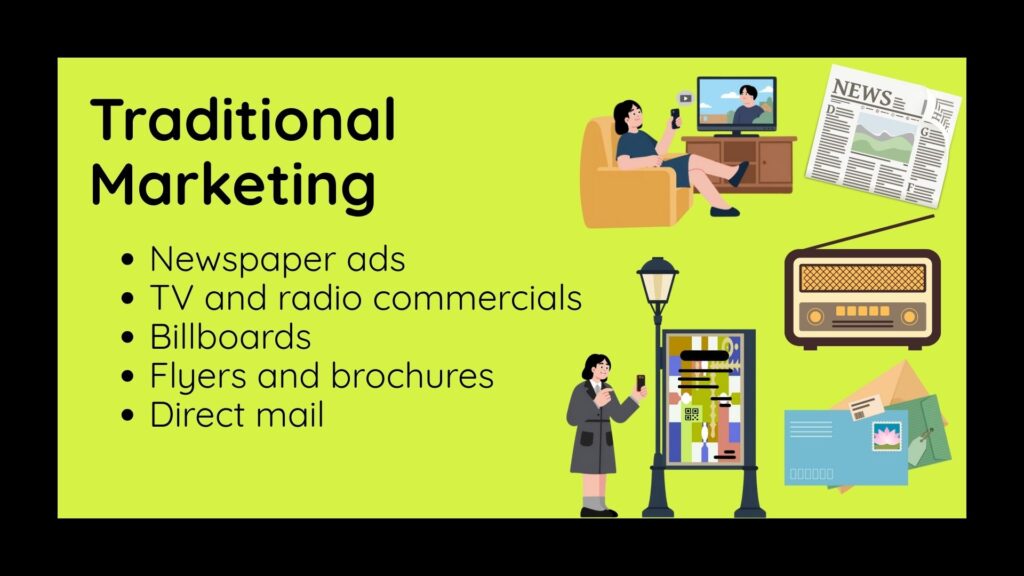
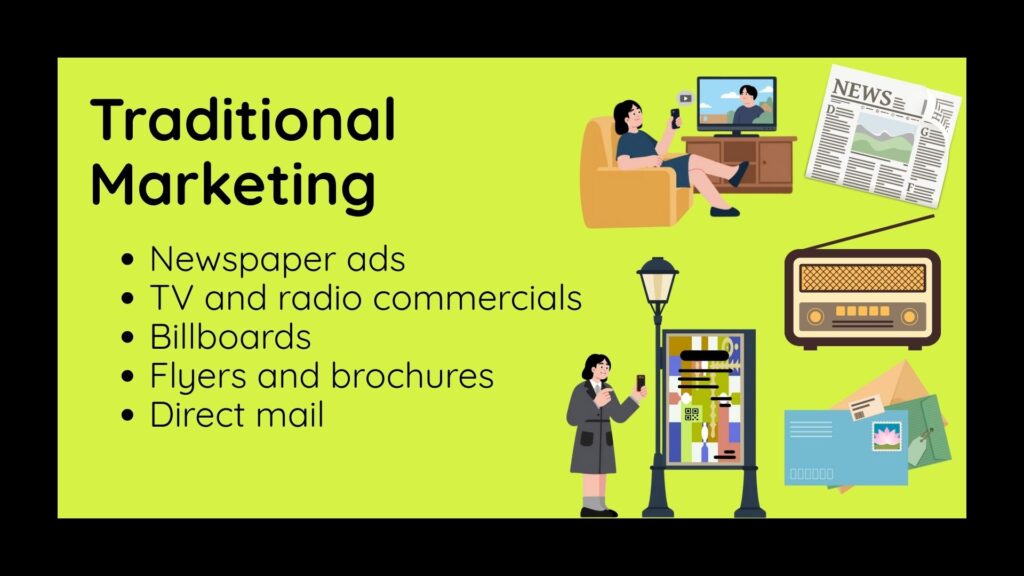
Traditional marketing refers to natural marketing methods such as:

● Newspaper ads
● TV and radio commercials
● Billboards
● Flyers and brochures
● Direct mail 

These methods focus on mass audience exposure, not precise targeting.

What Is Digital Marketing?

Digital marketing uses online channels to promote businesses, including:

● Search engines (Google)
● Social media (Facebook, Instagram, TikTok)
● Email marketing
● Websites and blogs
● Online advertising (Google Ads, Meta Ads) 

Digital marketing focuses on targeted, measurable, and scalable growth.

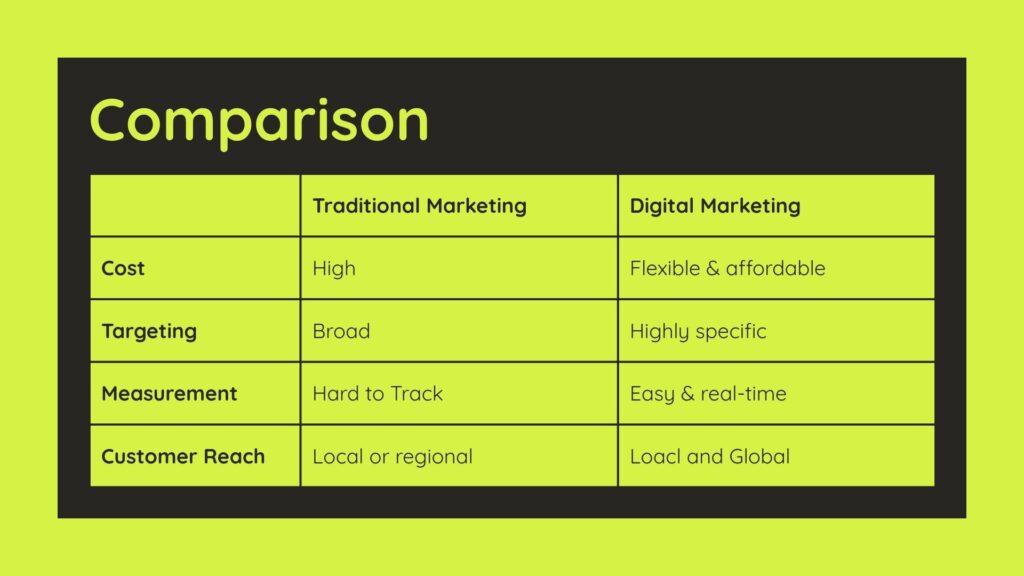
Digital Marketing vs Traditional Marketing (Simple Comparison) 

Feature
Traditional Marketing
Digital Marketing
CostHighFlexible & Affordable
TargetingBroadHighly Specific
MeasurementHard to TrackEasy & Real-Time
Customer ReachLocal or RegionalLocal + Global
ROIUnclearData-Driven
ScalabilityLimitedHighly Scalable

This comparison alone explains why digital marketing is important in 2026.

Cost of Traditional Marketing vs Digital Marketing ROI

Traditional Marketing Cost Reality

For small businesses, traditional marketing can be expensive:
● Newspaper ad: $500–$5,000
● Radio ad: $1,000+ per campaign
● Billboard: Thousands per month 

And the biggest problem?

You can’t accurately measure results.

Digital Marketing ROI for Small Businesses

 
Digital marketing allows you to:

● Start with small budgets
● Track every click, lead, and sale
● Stop campaigns that don’t work
● Scale what performs best

This is why digital marketing ROI for small businesses is significantly higher than traditional marketing.

Offline vs Online Marketing Effectiveness in 2026

Consumer behavior has changed, especially in the USA. 

Today’s customers:

● Search on Google before buying
● Read online reviews
● Compare prices online
● Follow brands on social media 

Offline vs online marketing effectiveness clearly favors digital channels because that’s where customers spend their time.

Traditional Marketing Examples (Still Useful?)

Traditional marketing is not dead, but its role has changed. 

Traditional Marketing Still Works For:

● Local brand awareness
● Community events
● Physical store visibility 

Example:
A local restaurant using:

● Flyers for nearby neighborhoods
● Sponsoring a local event 

But even then, digital marketing should support it.

Digital Marketing Channels for Startups & Small Businesses

Digital marketing gives entrepreneurs access to powerful channels: 

Key Digital Marketing Channels in 2026:

● SEO (Search Engine Optimization)
● Social Media Marketing
● Email Marketing
● Paid Advertising
● Content Marketing
These channels are ideal for digital marketing for entrepreneurs and startups because they are flexible and measurable.

Traditional Marketing for Small Businesses: Limitations

 
Small businesses face real challenges with traditional marketing:

● High upfront cost
● Limited customer reach
● No targeting by age, interest, or behavior
● Difficult to measure success
● Hard to scale 

This makes traditional marketing for small businesses risky in 2026. 

Digital vs Traditional Advertising: Target Audience Matters

One of the biggest advantages of digital marketing is precise targeting.

Target Audience in Digital Marketing

 
You can target customers by:

● Location (USA, state, city)
● Age & gender
● Interests & behavior
● Search intent 

Traditional advertising shows ads to everyone, even people who are not interested.
That’s why digital vs traditional advertising is not a fair fight anymore. 

Local Business Marketing Methods: USA Focus

For US-based businesses, digital marketing is a local growth engine. 

Local Digital Marketing Tools:

● Google Business Profile
● Local SEO
● Online reviews
● Location-based ads 

Example:

A local plumber in Texas ranking for “emergency plumber near me” will outperform any flyer or newspaper ad. 

Marketing Strategies for Entrepreneurs in 2026

Entrepreneurs need scalable marketing strategies that grow with the business. 

Best Marketing Strategies for Entrepreneurs:

● SEO for long-term traffic
● Social media for brand building
● Paid ads for fast leads
● Email marketing for retention
These strategies outperform traditional marketing in both cost and results.

Measuring Marketing Performance: igital Wins

One major reason why every business needs digital marketing is performance tracking. 

Digital Marketing Allows You to Track:

● Website traffic
● Leads & conversions
● Cost per customer
● ROI
● User behavior 

Traditional marketing offers guesses, digital marketing offers data. 

Brand Awareness: Traditional vs Digital

Traditional marketing builds awareness slowly and expensively. 

Digital marketing builds awareness:

● Faster
● Cheaper
● With measurable reach
● Through repeated online exposure 

This makes digital marketing ideal for small brands and startups. 

Marketing Budget for Entrepreneurs: Smart Spending

Entrepreneurs need control over their marketing budget. 

Digital Marketing Budget Advantages:

● Start small
● Adjust anytime
● Pause or scale instantly
● No long-term contracts 

Traditional marketing often locks you into fixed, expensive commitments.

Customer Reach: Traditional vs Digital

 
Aspect
Traditional Marketing
Digital Marketing

Local Reach

LimitedStrong
National ReachExpensiveAffordable
Global ReachVery CostlyEasy
Repeat ExposureHard

Easy

This is why digital marketing offers greater customer reach in 2026.

Marketing Tools for Entrepreneurs (Digital Advantage)

 
Digital marketing comes with powerful tools:

● Google Analytics
● Google Search Console
● Social media insights
● Email automation
● AI-powered tools 

These tools help small businesses optimize and grow faster.

Why Every Business Needs Digital Marketing in 2026 (Final Verdict)

Let’s be clear:
Traditional vs Digital Marketing is no longer a debate. 

Traditional marketing:

● Is expensive
● Is hard to measure
● Has limited reach 

Digital marketing:

● Is affordable
● Is measurable
● Scales with your business
● Matches modern customer behavior

For small business owners in the United States, digital marketing is the smart, future-ready choice.

Conclusion: Adapt Now or Fall Behind

Businesses relying solely on traditional marketing will struggle by 2026.
Businesses that embrace digital marketing for entrepreneurs, local SEO, online advertising, andbdata-driven strategies will win market share. 

✅Call-to-Action (CTA) Click Here

Review your current marketing strategy
Shift budget from low-performing traditional ads
Invest in digital marketing channels that deliver measurable growth 

The future belongs to businesses that market smarter, not harder. 

FAQs – Traditional vs Digital Marketing (SEO)


What is the main difference between traditional and digital marketing?

Traditional marketing is offline and broad, while digital marketing is online, targeted, and measurable.

Is traditional marketing still effective in 2026?

It can support brand awareness, but digital marketing delivers better ROI and growth. 

Why is digital marketing better for small businesses?

It is affordable, scalable, and allows precise targeting with clear results. 

Can small businesses combine traditional and digital marketing?

Yes, but digital marketing should be the primary focus. 

Which marketing strategy is best for entrepreneurs in the USA?

A combination of SEO, email marketing, paid ads, and social media works best. 

My Real-World Experience Learning Digital Marketing

When I started writing content to genuinely help users, I noticed organic traffic from the United States slowly growing. Many students enter digital marketing expecting quick income, but based on my experience, focusing on learning and real practice first always leads to better long-term results. Using tools like Google Search Console helped me understand what people are actually searching for. At first, it felt confusing, but regular use made it easier to analyze real user behavior. At one point, I focused too much on writing for search engines instead of real readers. Once I shifted my approach to helping people first, my content performance improved.
If you are a student or beginner, digital marketing can be a realistic and future-proof career, as long as you stay patient and trust the learning process instead of chasing shortcuts. 

✍ Author Bio (E-E-A-T Fix) Click Here

Written by Techlo Solution

Digital Marketing Learner & SEO Practitioner
Helping beginners and students understand online marketing in simple words.
Running a small business in the United States has never been easy—and in 2026, competition is tougher than ever. Customers are smarter, markets are crowded, and almost every buying decision starts online.

Why Every Business Needs Digital Marketing in 2026

A Complete Guide for Small Business Owners in the United States

Running a small business in the United States has never been easy—and in 2026, competition
is tougher than ever. Customers are smarter, markets are crowded, and almost every buying
decision starts online.

If you’re a small business owner asking:
  •  How do I get more customers online?
  • How can my business compete with big brands?
  • Is digital marketing really necessary in 2026?

The short answer is yes—digital marketing is no longer optional.

In this guide, you’ll learn why digital marketing is important, how it helps small businesses grow,
and the best digital marketing strategies for small businesses in 2026, explained in simple
English.

Why Digital Marketing Is Important in 2026

Consumer behavior has permanently shifted online.
In 2026:

● Customers search on Google before buying
● Reviews influence purchasing decisions
● Social media shapes brand trust
● AI-driven recommendations guide choices

If your business is not visible online, you are invisible to customers.

Key Reality for US Small Businesses

Your competitors are already using digital marketing.
If you don’t, you’re losing customers—daily.
This is why digital marketing for small businesses is critical for survival and growth.

Digital Marketing in 2026: What’s Changed?

Digital marketing in 2026 is:

● More data-driven
● More personalized
● Powered by AI and automation
● Focused on local and mobile users

Small businesses now have access to the same tools once used only by large corporations—at affordable costs.

How Digital Marketing Helps Small Businesses Grow

Let’s break down how digital marketing helps small businesses grow, step by step.

1. Helps You Get Found Online (Local & National)

Most US customers search like this:
● “Best plumber near me.”
● “Local bakery in Chicago.”
● “Affordable online store USA.”

With online marketing for small businesses in the USA, you can appear exactly when customers are searching.

Tools used:

● Google Business Profile
● Local SEO
● Website optimization

2. Levels the Playing Field with Big Brands

One of the biggest benefits of digital marketing for small businesses is fair competition.
You don’t need a large expenditure to win online.

With the right digital marketing strategies in 2026, small businesses can:

● Rank on Google
● Run targeted ads
● Build loyal communities
● Compete with national brands

3. Drives Real Business Growth (Not Just Likes)

Digital marketing focuses on results, not vanity metrics.
It helps you:

● Get more leads
● Increase online sales
● Build repeat customers
● Track ROI clearly

This is why digital marketing is essential for business growth in 2026.

Core Digital Marketing Strategies for Small Businesses in 2026

Let’s look at the best digital marketing strategies for small businesses in 2026.

Search Engine Optimization (SEO) for Small Businesses

SEO helps your business appear on Google without paying for every click.

Why SEO matters in 2026:

● 75% of users never go past page one
● Local searches convert faster
● Long-term traffic growth

Example (USA-focused):

A local HVAC business optimized for “AC repair in Texas” and doubled calls within 6 months.
Content Marketing That Builds Trust
Content marketing is about educating before selling.

Examples:

● Blog posts
● How-to guides
● Videos
● FAQs

Content builds authority and helps customers trust your brand—especially important for small businesses.

Social Media Marketing Trends 2026

Social media is no longer optional.

In 2026, trends include:

● Short-form videos (Reels, Shorts)
● Community-based content
● Authentic behind-the-scenes posts
● AI-assisted content creation

Platforms small businesses should focus on:

● Instagram
● Facebook
● TikTok
● LinkedIn (for B2B)

Paid Ads (Affordable & Targeted)

Paid advertising has become smarter and more affordable.

With online marketing solutions for US small businesses, you can:

● Target by location
● Target by interest
● Control the budget daily
● Track conversions

Platforms include:

● Google Ads
● Facebook & Instagram Ads
● YouTube Ads

Email Marketing & Automation

One of the largest ROIs is still achieved through email marketing.

In 2026, automation allows:

● Welcome email sequences
● Abandoned cart reminders
● Personalized offers

This is especially powerful for small businesses with limited time.

AI in Digital Marketing for Small Businesses (2026 Trend)

AI is no longer just for the largest businesses.

In 2026, small businesses use AI for:

● Content ideas
● Ad optimization
● Customer chatbots
● Email personalization

AI helps small business owners save time and money, making digital marketing more efficient.

Voice Search Optimization for Small Businesses

More Americans now use:

● Siri
● Alexa
● Google Assistant

Voice search optimization focuses on:

● Conversational keywords
● Local intent
● Mobile-first design

Example:

“Where is the best pizza place near me?”
Optimizing for voice search gives you an edge in local US markets.

 How to Market a Small Business Online in 2026

If you’re wondering how to market a small business online, follow this simple framework:

Step 1: Build a Strong Online Presence

● Website
● Google Business Profile
● Social media pages

Step 2: Choose the Right Channels

● SEO for long-term growth
● Social media for engagement
● Ads for quick results

Step 3: Track & Improve

● Use analytics
● Test strategies
● Improve monthly

Ways to Increase Online Sales for Small Businesses

Digital marketing directly impacts sales.

Effective methods include:

● Retargeting ads
● Email follow-ups
● Local SEO optimization
● Strong calls to action

These are proven digital marketing ideas for small business owners.

Affordable Digital Marketing for American Small Enterprises

One myth is that digital marketing is expensive.
In reality:
● SEO is cost-effective in the long term
● Social media is low-cost
● Ads can start with small budgets

Many businesses work with a digital marketing agency for small businesses in the USA to get
expert help without hiring full-time staff.

Why Every Small Business Needs Digital Marketing

(Summary)

Let’s be clear:
Why every small business needs digital marketing in 2026:
● Customers are online
● Competition is digital-first
● Growth depends on visibility
● Marketing must be measurable
● Automation saves time

Without digital marketing, small businesses risk falling behind.

Conclusion: The Future Belongs to Digitally Smart Businesses

Digital marketing in 2026 is not about trends—it’s about survival and growth.
Whether you run:
● A local store
● A service-based business
● An online shop
● A startup

Digital marketing helps you reach more customers, build trust, and grow consistently.

✅ Call-to-Action (CTA) Click Here

👉 Start today by investing in SEO, content, or social media marketing
👉 Audit your online presence
👉 Consider professional digital marketing services for small businesses
The businesses that win in 2026 are the ones that act today.

FAQs – Digital Marketing for Small Businesses (SEO)

Why is digital marketing critical for small businesses in 2026?

Because customers search, compare, and buy online. Digital marketing helps small businesses
stay visible and competitive.

Is digital marketing affordable for small businesses in the USA?

Yes. Many strategies like SEO, content marketing, and email marketing are budget-friendly.

How can small businesses compete online with big brands?

By focusing on local SEO, niche audiences, and personalized marketing.

What is the unique digital marketing strategy for small businesses in 2026?

A mix of SEO, social media marketing, content, and paid ads works best.

Should small businesses hire a digital marketing agency?

If the budget allows, working with a digital marketing agency for small businesses in the USA
can save time and deliver better results.

My Real-World Experience Learning Digital Marketing

When I first started learning digital marketing, terms like SEO, Google Ads, and content
Marketing felt overwhelming. I honestly thought this field was only for tech experts, but with
consistent practice, I realized that beginners can learn digital marketing step by step. In the
beginning, I made the mistake of trying to learn everything at once, which only created
confusion.

✍️ Author Bio (E-E-A-T Fix) Click Here

Written by Techlo Solution
Digital Marketing Learner & SEO Practitioner
Helping beginners and students understand online marketing in simple words.
Digital Marketing for Beginners in USA – Complete Guide

Digital Marketing for Beginners in USA – Complete Guide

What Is Digital Marketing? A Complete Beginner’s Guide for Students in the USA

If you are a student or beginner in the United States and you keep hearing terms like SEO, social media marketing, Google Ads, or online marketing, you might be wondering:

What is digital marketing, and where do I even start?

Short answer: Yes, digital marketing is easy to start, beginner-friendly, and full of career opportunities, especially in the USA. This digital marketing guide for beginners will explain everything in simple English, with real examples, practical tips, and a clear learning path.

What Is Digital Marketing

What Is Digital Marketing? (Meaning & Definition)

What is digital marketing?

Digital marketing is the practice of promoting products, services, or brands through digital channels such as search engines, websites, social media, email, and online advertising.

In other words, digital marketing means marketing on the internet.

Digital Marketing Definition (Simple)

Digital marketing means using online channels to reach the right audience, at the right time, with the right message.

This is also known as:

  • Online marketing
  • Internet marketing
  • Digital advertising

Digital Marketing Explained Simply (Beginner Friendly)

In the past, businesses relied on:

  • TV commercials
  • Newspapers
  • Billboards

Today, people in the USA:

  • Search on Google
  • Scroll Instagram & TikTok
  • Watch YouTube
  • Read emails

That’s why digital marketing is more powerful than traditional marketing.

Real Example (USA-Based)

As a digital marketing learner, I saw my first blog reach 1,000 visitors from the United States by using only SEO basics and helpful content—no paid ads.
 This is how digital marketing works when done correctly.

Why Digital Marketing Is Important (Especially in the USA)

Digital marketing is important because American consumers live online.

Key Facts:

  • Over 90% of adults in the USA use the internet daily
  • Google processes 8+ billion searches per day

Businesses can target users by location, age, interests, and behavior

Benefits of Digital Marketing

  • Lower cost than TV or print ads
  • Easy performance tracking
  • Local and global reach
  • High-demand skills

Flexible careers (remote & freelance)

Online Marketing Basics: How Digital Marketing Works

 Digital marketing follows a simple process:
  1. Attract visitors (SEO, social media, ads)
  2. Engage them with helpful content
  3. Convert them into leads or customers
  4. Retain them with email & remarketing

This system is called a digital marketing funnel.

Core Digital Marketing Channels (Basics for Beginners)

Let’s break down the most important digital marketing basics.

Search Engine Optimization (SEO Basics)

SEO helps your website appear on Google when people search.

Example:

“Digital marketing for beginners in the USA”

SEO includes:

  • Keyword research
  • Content optimization
  • Page speed
  • User experience

SEO is one of the best skills to learn in digital marketing step by step.

Content Marketing Basics

Content marketing means creating valuable content, such as:

  • Blog posts
  • Videos
  • Guides
  • Tutorials

Example:

 A digital marketing guide for students that teaches without selling.

Social Media Marketing Basics

Social media marketing uses platforms like:

  • Instagram
  • TikTok
  • Facebook
  • LinkedIn

US brands use social media to:

  • Build trust
  • Grow audiences
  • Drive website traffic

Email Marketing for Beginners

Email marketing helps businesses stay connected.

Common uses:

  • Newsletters
  • Student discounts
  • Course updates
  • Brand announcements

Email marketing still has one of the highest ROI in online marketing.

Pay-Per-Click Advertising (PPC Basics)

PPC means you pay only when someone clicks your ad.

Popular platforms:

  • Google Ads
  • Facebook Ads
  • YouTube Ads

Perfect for:

  • Local US businesses
  • New product launches
  • Quick traffic

Digital Marketing for Beginners: Step-by-Step Roadmap

If you want to learn digital marketing step by step, follow this roadmap:

Step 1: Learn Basics

  • Digital marketing meaning
  • Internet marketing basics
  • How online marketing works

Step 2: Pick One Skill

  • SEO
  • Social media marketing
  • Content marketing
  • PPC basics

Step 3: Practice

  • Start a blog
  • Create a LinkedIn page
  • Try free tools

Step 4: Use Tools

  • Google Analytics
  • Google Search Console
  • Canva
  • Email tools

Digital marketing is one of the best careers for students in the United States.

Why Students Choose Digital Marketing:

  • No technical degree required
  • Learn online from anywhere
  • High-paying entry-level jobs
  • Freelancing & remote work

Digital Marketing Skills for Students

  • SEO basics
  • Content writing
  • Social media strategy
  • Analytics
  • Email marketing

Entry-Level Digital Marketing Jobs (USA)

  • Digital Marketing Assistant
  • SEO Intern
  • Content Marketing Executive
  • Social Media Coordinator
  • PPC Assistant

Digital Marketing Examples (Real-World)

  • Amazon → Email marketing
  • Nike → Social media campaigns
  • Local US restaurants → Google Maps SEO
  • Bloggers → Content marketing income

Current & Future Digital Marketing Trends

The future of digital marketing includes:

  • AI tools
  • Voice search
  • Short-form video
  • Personalization
  • Automation

Digital marketing is growing faster every year in the USA.

Advantages of Online Marketing Over Traditional Marketing

Digital Marketing

Traditional Marketing

Low cost

High cost

Measurable

Hard to track

Targeted

Broad

Flexible

Fixed

Beginner Tips to Succeed in Digital Marketing

  • Focus on learning, not shortcuts
  • Practice daily
  • Start small
  • Follow US-based blogs
  • Be patient

Conclusion: Start Learning Digital Marketing Today

Now you understand what is digital marketing is, how it works, and why it is perfect for beginners and students in the USA.

Digital marketing is not magic, it’s a skill you can learn step by step.

✅ Call-to-Action Click Here

  • Start today by learning SEO basics or content marketing.
  • Save this digital marketing guide for beginners.
  • Share it with students who want a future-proof career.

FAQs – Digital Marketing for Beginners


What is digital marketing in simple words?

Digital marketing means promoting products or services online.

Is digital marketing good for beginners?

Yes, it is beginner-friendly and easy to start.

Can students learn digital marketing?

Yes, digital marketing for students is one of the best career choices today.

How long does it take to learn digital marketing?

3–6 months for basics with practice.

Are digital marketing jobs available in the USA?

Yes, demand for entry-level digital marketing jobs is very high.

My Real-World Experience Learning Digital Marketing

When I first started learning digital marketing, terms like SEO, Google Ads, and content marketing felt overwhelming. I honestly thought this field was only for tech experts, but with consistent practice, I realized that beginners can learn digital marketing step by step. In the beginning, I made the mistake of trying to learn everything at once, which only created confusion. Once I focused on one skill at a time, especially SEO basics, my understanding improved significantly. While learning SEO, I discovered that simply adding keywords is not enough. When I started writing content to genuinely help users, I noticed organic traffic from the United States slowly growing. Many students enter digital marketing expecting quick income, but based on my experience, focusing on learning and real practice first always leads to better long-term results. Using tools like Google Search Console helped me understand what people are actually searching for. At first, it felt confusing, but regular use made it easier to analyze real user behavior. At one point, I focused too much on writing for search engines instead of real readers. Once I shifted my approach to helping people first, my content performance improved. If you are a student or beginner, digital marketing can be a realistic and future-proof career, as long as you stay patient and trust the learning process instead of chasing shortcuts.

✍️ Author Bio (E-E-A-T Fix)

Written by Techlo Solution
Digital Marketing Learner & SEO Practitioner
Helping beginners and students understand online marketing in simple words.