
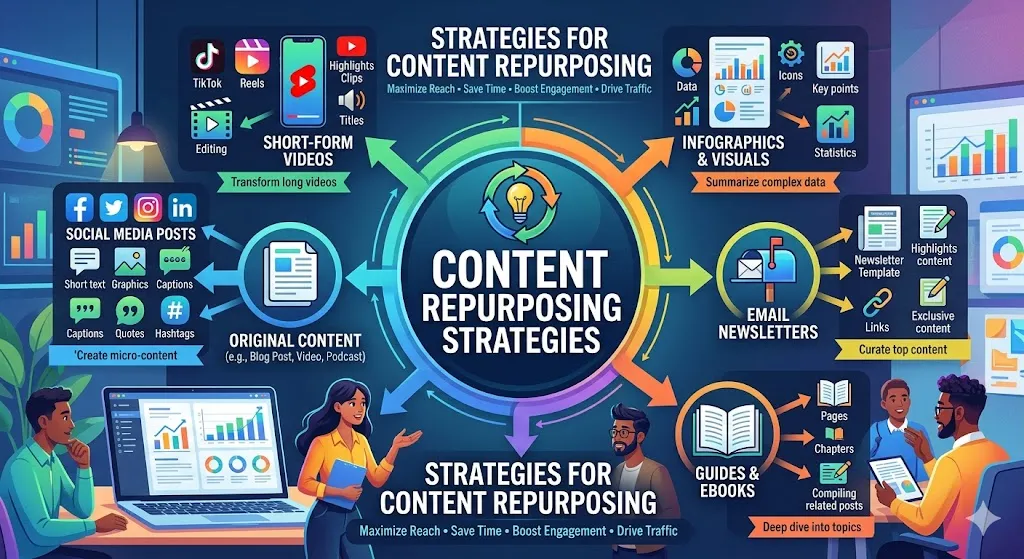
In today’s digital marketing era, content curation isn’t enough – the real challenge is how to get the most value out of your existing content. This is where the concept of a content repurposing strategy comes in. If you write a blog post and forget about it by publishing it somewhere, you’re literally wasting thousands of dollars. The world’s top marketers and content creators know that converting original content into multiple formats can improve all three – organic traffic, social media engagement, and SEO rankings.
This article will walk you through step-by-step what content repurposing is, how to do it effectively, and how brands around the world have used it successfully through real-world case studies. If you’re a blogger, YouTuber, freelancer, or digital marketing student — this guide is for you.
What’s content repurposing?
Repurposing is a strategy in which you convert your existing content into new formats or distribute it on new platforms — without having to find a new topic. Imagine if you wrote a 2,000- word SEO-friendly blog post. With our content, you can create:
YouTube VideoInstagram CarouselTwitter/X ThreadLinkedIn ArticlePodcast EpisodeEmail NewsletterPinterest InfographicShort Reels/TikTokDownloadable PDF GuideWebinar Slide Deck
This surf is not a way to save you time- it’s a smart content marketing strategy that quickly increases your brand exposure. Different audiences are on different platforms, and each format reaches a new followership segment.
Why is repurposing content essential?
According to a exploration study, 29 of happy marketers constantly repurpose their content – everyone additional publishes once and moves on. That’s a huge mistake. Here are some great reasons why a content repurposing strategy is important for your digital growth.
1. ROI Multiplies
The effort and cost involved in writing a single blog post — exploration, writing, editing, formatting all happen once.However, your return on investment( ROI) increases10-fold without any fresh exploration, If you convert a single post into 10 different formats.
2. SEO Boost Multiplies
When you cover the same topic on multiple platforms and backlink or cite it to your main blog post, Google sees you as a topical authority on the topic. This improves search engine rankings.
3. Expands audience reach
Some people like to listen to podcasts, some like to watch Instagram reels, some like to read LinkedIn articles. With multi-platform content distribution, you reach audiences who noway read your blog.
4. Brand Relevancy is erected
When the same communication is seen over and over again in different formats, brand recall is naturally strengthened. In marketing psychology, there’s something called the “Rule of 7” – the average person encounters a communication 7 times before they accept it.
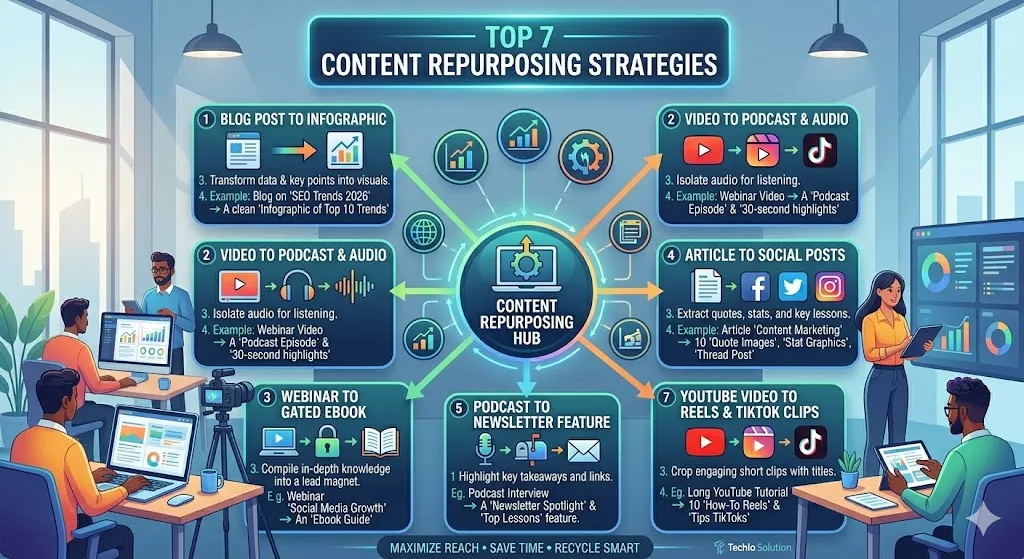
Top 7 Content Repurposing Strategies (with Examples)
Strategy# 1 Blog Post → YouTube Video
This is the most popular and effective content repurposing technique. Convert the crucial points of your blog post into a script and turn it into a talking head or screen- recorded video. YouTube is the second largest search engine in the world, and you can drive massive amounts of transnational organic traffic from there.
Pro Tip be sure to include a link to your original blog post in the videotape description. This backlink strategy improves your domain authority and drives viewers to your website.
Strategy# 2 Blog Post → Instagram/ LinkedIn Carousel
Carousel posts are the most secure and shareable content format on Instagram and LinkedIn. Convert 5- 10 crucial takeaways from your blog post into visually appealing slides. Each slide should cover a crucial point, and the last slide should have a clear call to action (CTA) — “Link in bio to read the full article.”
Strategy# 3 Blog Post → Podcast Episode
The number of podcast listeners worldwide is growing rapidly. By 2024, further than 500 million people worldwide will be listening to podcasts regularly. Convert your blog post into a conversational podcast episode. Do n’t just read your article — expand on it, give examples, and add particular perceptivity.
Strategy# 4 Long- Form Article → Twitter/ X Thread
Long- form threads on Twitter are extremely viral for users who want in- depth information. Turn the main points of your article into a thread of 10- 15 tweets. Each tweet should give a standalone insight, and the first tweet in the thread should be compelling enough to click “Read More.”
Strategy# 5 Content → Email Newsletters
Your email list is your most precious marketing asset – it’s not affected by algorithm changes. Rework your stylish blog posts into an email newsletter. Write a summary, give 3 crucial takeaways in bullet points, and give a link to the full article. This improves email open rates and click- through rates
Strategy# 6 Multiple Blog Posts → free eBook/ Lead Magnet
Still, create a free eBook or downloadable PDF guide to collect, if you have 5- 10 affiliated blog posts on the same content. This can be your most important supereminent generation tool. Log in to your email in exchange for precious resources – and it organically grows your email list.
Strategy# 7 Webinars/ Live Streams → Evergreen Content
Still, record them Andre-create them, If you do live webinars or Q&A sessions. A 60- minute webinar can yield a YouTube video, 5- 6 short clips for Reels TikTok, a detailed blog post summary, and a podcast episode. This evergreen content strategy maximizes the output of your efforts.
Real- World Case Studies
Case Study# 1 — HubSpot
A Research Report → 50 Content Pieces
HubSpot — the world’s leading inbound marketing platform — had to rework over 50 content pieces for its periodic “State of Marketing” exploration report. They came up with the following infographics, blog posts, social media posts, podcast episodes, webinars, and email sequences. What makes this strategy so effective is that they constantly grow their organic traffic year after year and maintain topical authority in their industry.
Crucial Lesson Research- backed content is ideal for repurposing because statistics and data points are just as precious in different formats.
Case Study# 2 — Gary Vaynerchuk (GaryVee)
The “Document, Do not Create” Philosophy
GaryVee — Joe is a prominent digital marketing influencer — popularizing the “document, do n’t create” philosophy. His team spends a full day filming, and what we get from the raw footage is a long- form YouTube videotape, 30- 40 short clips for TikTok/ Instagram, multiple LinkedIn posts, podcast episodes, and blog post summaries. This content repurposing machine produces hundreds of pieces of content each week, making it worth Gary V’s redundant time investment.
Crucial Lesson make your repurposing strategy around a central “pillar of content” piece this is called the “content pyramid” model.
Case Study# 3 — Neil Patel
Blog from podcast to YouTube funnel
SEO expert Neil Patel uses blog posts, podcasts, and YouTube videos as a cohesive channel in his content strategy. He publishes content on the same topic in ten formats, as if he were getting triple the visibility on each topic. This strategy is why NeilPatel.com attracts millions of unique organic visitors per month. His case easily demonstrates that repurposing cross-platform content yields compounding returns in the long run.
Crucial lesson covering the same topic in multiple formats is also salutary for SEO — Google improves your EET (Experience, Expertise, Authority, and Trust) score.
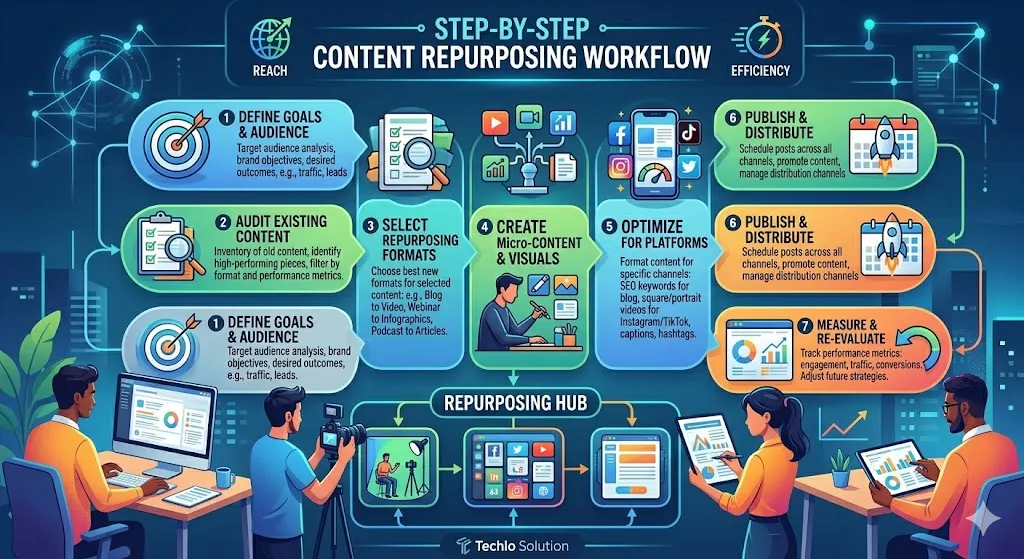
Content Repurposing Workflow Step by Step
Follow this workflow to create an effective content repurposing system
Step 1 Identify your pillar content.
Just repurpose content. First, identify your best- performing content — blog posts or vids that are already generating traffic or engagement. This is the most ideal “proven” content to repurpose.
Step 2 Platform Audit
See where your target followership is However, LinkedIn and email marketing are more effective, if you’re targeting a B2B followership. For B2C, Instagram, TikTok, and YouTube are better platforms.
Step 3 Create a Content Calendar
Create a content repurposing calendar that outlines what content you plan to publish on which platform when. Tools like Notion, Trello, or CoSchedule can streamline this process.
Step 4 Format- Specific Adaptations
Surf dupe paste meets crane! Each platform has its own native content style. Visually charming graphics are essential for Instagram, terse and terse writing for Twitter, professional tone for LinkedIn. We adapt the content authentically to the platform.
Step 5 Track, measure, optimize.
Track the performance of each repurposed piece. Google Analytics, Instagram Insights, LinkedIn Analytics – all these tools tell you which format is performing stylish where. Unborn decisions need to be reframed based on ISI data.
Common Mistakes to Avoid.
Numerous early content repurposes do n’t implement the dark side of the coin. Then are some common mistakes
Mistake# 1 — advertisement the same content Copy- pasting the same text across platforms is n’t effective. Each platform’s algorithm and followership behavior are different.
Mistake# 2 — Sacrificing quality Repurposing for quantity. A poorly designed infographic can damage a brand’s reputation. Maintain quality in each repurposed piece.
Mistake# 3 — reusing old/ outdated content Reusing evergreen content or recently updated content. Content with outdated statistics can be further of a draw.
Mistake# 4 — No clear CTA Every repurposed piece should have a clear call to action — whether it’s a blog visit, email subscription, or product purchase.
Stylish Tools for Repurposing Content
These tools are great for streamlining your content repurposing workflow
- Cana — for turning blog content into visually engaging infographics, carousels, and social posts.
- Narration — automatically transcribes audio/ video content, making it easy to create blog posts.
- Automatically distributes content across multiple platforms.
- Loom/ Riverside.fm — for high- quality video recording for later repurposing.
- ChatGPT/ CloudAI — for quickly adapting long- form content into a variety of formats — summaries, social headlines, email copy, and more.
The result: one piece, unlimited reach
A content repurposing marketing strategy is a complete growth mindset shift. Once you start thinking “where else and for whom can this content work?” – your digital presence will grow exponentially. HubSpot says GaryVee, the world’s most successful content marketers use the strategy as a primary goal for their businesses.
Start with a single pillar content piece. Use repurposing in 5 different formats. Track results. And then scale. Remember – “work smarter, not harder” – that’s the core message of a content repurposing strategy. And if you practice this consistently, your website will not only attract international traffic but also become a trusted digital brand.