

Your website looks great. The design is clean, the content is solid, and you’ve put in real effort. Yet Google traffic from the United States stays flat or even drops. Sound familiar?
Google’s algorithms are more intelligent than ever in 2026. A single crawl error, slow page, or missing meta tag can push your site off page one—especially for competitive U.S. searches. The fix? A regular SEO audit checklist for website owners.
This guide is written in simple English for beginners. You’ll get a complete SEO audit checklist 2026, a clear website SEO audit step by step, and exactly how to do an SEO audit for a website without hiring an expensive expert. Whether you run a small business site in Texas, an e-commerce store in California, or a blog targeting New York readers, these practical steps will help you find and fix problems fast.
My Real-World Experience Learning Digital Marketing
When I first started learning digital marketing, terms like SEO, Google Ads, and content marketing felt overwhelming. I honestly thought this field was only for tech experts, but with consistent practice, I realized that beginners can learn digital marketing step by step. In the beginning, I made the mistake of trying to learn everything at once, which only created confusion. Once I focused on one skill at a time, especially SEO basics, my understanding improved significantly. While learning SEO, I discovered that simply adding keywords is not enough. When I started writing content to genuinely help users, I noticed organic traffic from the United States slowly growing. Many students enter digital marketing expecting quick income, but based on my experience, focusing on learning and real practice first always leads to better long-term results. Using tools like Google Search Console helped me understand what people are actually searching for. At first, it felt confusing, but regular use made it easier to analyze real user behavior. At one point, I focused too much on writing for search engines instead of real readers. Once I shifted my approach to helping people first, my content performance improved. If you are a student or beginner, digital marketing can be a realistic and future-proof career, as long as you stay patient and trust the learning process instead of chasing shortcuts.
That same step-by-step mindset turned my own site audits into real traffic wins—and it will work for you too.
What Is an SEO Audit and Why Every Website Owner in the USA Needs One
An SEO audit is a full health check for your website. It looks at technical issues, content quality, user experience, and more to see why you’re not ranking higher.
In 2026, U.S. website owners face tougher competition. Google’s Helpful Content Update and page experience signals reward fast, mobile-friendly, trustworthy sites. A quick audit can uncover hidden problems that are costing you local customers in Chicago, Los Angeles, or Miami. Regular audits help you fix SEO issues on your website before they hurt your rankings.
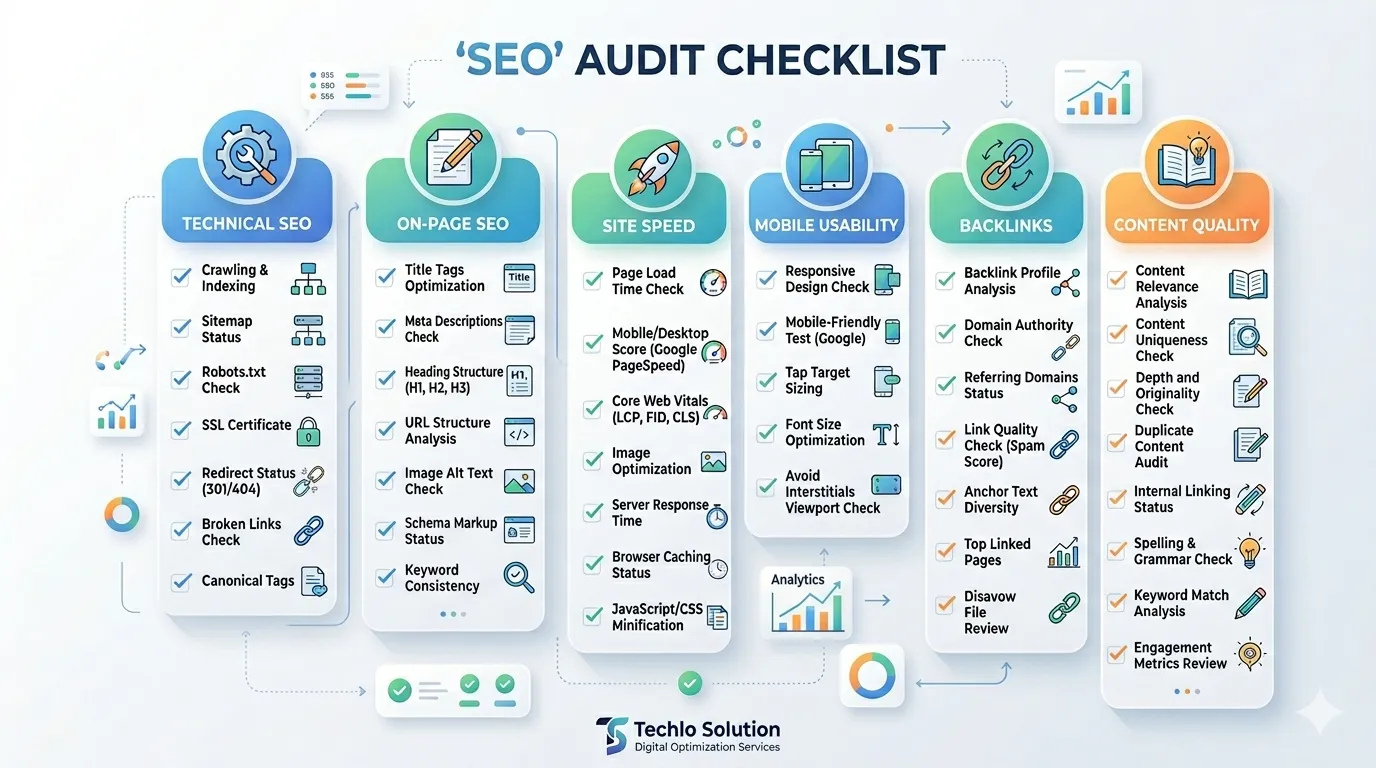
Your Complete SEO Audit Checklist for Website Owners (2026 Edition)
Print or save this complete SEO audit checklist 2026 and run it every 90 days:
- Technical SEO audit checklist
- On-page SEO audit checklist
- Google Search Console review
- Site speed and Core Web Vitals analysis
- Mobile usability check
- Local SEO audit checklist for small business
- Backlink profile review
- Content quality and duplicate content scan
- Internal linking structure audit
- XML sitemap and robots.txt check
Follow the checklist below and you’ll have a clear website SEO analysis checklist that actually delivers results.
How to Do an SEO Audit for a Website Step by Step
Here is a simple website SEO audit step by step process any beginner can follow:
- Gather your tools – Free ones first (listed later).
- Run a full crawl of your site.
- Check indexing status in Google Search Console.
- Analyze on-page elements.
- Test speed and mobile experience.
- Review backlinks and local signals.
- Create a fix list with priorities.
- Track improvements after changes.
This SEO audit process and checklist takes 2–4 hours for most small sites and can boost rankings within weeks.

Technical SEO Audit Checklist: Fix the Foundation First
Start with the technical SEO audit checklist because Google must crawl and understand your site.
Key items to check:
- Crawl ability and indexing issues (use Google Search Console “Coverage” report).
- XML sitemap and robots.txt audit – make sure important pages are included and nothing is blocked.
- HTTPS and security checks – every page should be secure.
- Broken links and 404 errors fix – use a crawler to find and redirect them.
- Duplicate content detection – fix with canonical tags or 301 redirects.
Actionable tip: For U.S. sites, ensure your server response time is under 200ms. Slow servers hurt local searchers on mobile.
On-Page SEO Audit Checklist: Make Every Page Count
The on-page SEO audit checklist focuses on what visitors and Google see:
- Meta tags optimization audit – title and description should include your main keyword and feel natural.
- Keyword optimization analysis – primary keyword in H1, first paragraph, and naturally throughout.
- Heading structure (H1-H3) – logical and scan able.
- Image alt text and file names.
- Internal linking structure audit – at least 3–5 relevant links per post.
Example: A small business site in Florida improved rankings 40% after fixing thin meta descriptions on service pages.
Google Search Console Audit: Your Free Goldmine
Run a Google Search Console audit monthly. Look at:
- Performance report for top queries and clicks.
- Indexing issues and crawl errors.
- Mobile usability problems.
- Core Web Vitals data.
U.S. website owners who act on GSC data see faster local SEO wins because it shows real American search behavior.

Website Performance SEO Audit: Speed Matters in 2026
Website performance SEO audit is critical. Google uses page experience signals and Core Web Vitals.
What to measure:
- Largest Contentful Paint (LCP) under 2.5 seconds.
- Interaction to Next Paint (INP) under 200ms.
- Cumulative Layout Shift (CLS) under 0.1.
Fixes:
- Compress images and enable lazy loading.
- Use a CDN for U.S. visitors.
- Remove render-blocking resources.
Fast sites rank higher and keep visitors longer—especially mobile users searching locally.
Local SEO Audit Checklist for Small Business
If you serve customers in the United States, run this local SEO audit checklist for small business:
- Google Business Profile complete and active?
- NAP consistency across directories?
- Reviews managed and responded to?
- Location pages with unique content?
- Schema markup for Local Business added?
These steps help you rank in “near me” searches from coast to coast.
Backlink Profile Audit and Content Quality Check
Review your backlinks for quality. Remove toxic links and build natural ones from U.S. sites. Also scan for thin or duplicate content—Google penalizes low-value pages in 2026.
SEO Audit for WordPress Sites: Quick Wins
SEO audit for WordPress sites is easier with plugins:
- Use Rank Math or Yoast for on-page checks.
- Run free site crawlers like Screaming Frog.
- Check for bloated plugins slowing your site.
Most U.S. small business sites run on WordPress—auditing them regularly keeps them competitive.
Best SEO Audit Tools for Website Owners
SEO audit tools for website owners that won’t break the bank:
- Free: Google Search Console, Google Analytics 4, Page Speed Insights, Lighthouse.
- Affordable: Screaming Frog (free up to 500 URLs), Ubersuggest, SE Ranking.
Start free, upgrade when your site grows.
Creating Your SEO Audit Report Template
Build a simple SEO audit report template in Google Docs:
- Executive summary
- Priority issues (red/yellow/green)
- Action plan with deadlines
- Before-and-after metrics
Share it with your team or clients for clear next steps.
SEO Score Improvement Tips After Your Audit
After the audit, focus on high-impact fixes first. Track progress in Search Console. Most website owners see 20–50% traffic lifts within 60–90 days when they follow through.
Authoritative Resources for SEO Audit Checklist (2026 Guide)
An SEO audit is essential for improving website performance, fixing technical issues, and increasing organic traffic. These trusted industry resources from Google, Moz, HubSpot, and other authority platforms will help you perform a complete SEO audit effectively in 2026.
- Search Engine Journal – SEO Insights – Expert articles on SEO audits, algorithm updates, and optimization strategies.
- SEMrush SEO Audit Guide – Advanced SEO audit techniques including competitor analysis and site health checks.
- HubSpot SEO Audit Guide – Step-by-step guide for performing a complete SEO audit including technical and on-page SEO checks.
Strong Conclusion: Run Your SEO Audit Checklist Today
You now have everything you need: a full SEO audit checklist for website owners, step-by-step instructions, and 2026 trends that matter. Don’t wait for traffic to drop further.
Open Google Search Console right now and run your first quick audit. Pick three issues from the checklist and fix them this week. Your U.S. visitors—and Google—will reward you with better rankings and more customers.
Ready to take action? Drop your biggest SEO audit question in the comments below or bookmark this guide and schedule your next audit for next month. Your website deserves to rank higher—start today.
 Call-to-Action (CTA) Click Here
 Start today by investing in SEO, content, or social media marketing Audit your online presence Consider professional digital marketing services for small businesses
The businesses that win in 2026 are the ones that act today.
FAQs About SEO Audit Checklist for Website Owners
How often should I run a complete SEO audit checklist 2026?
Every 90 days, or after major site changes. Quarterly keeps most small U.S. sites healthy.
What is the easiest way to do a website SEO audit step by step?
Start with Google Search Console and Page Speed Insights, then use a free crawler. Follow the checklist above.
Do beginners need paid SEO audit tools for website owners?
No. Free Google tools plus Screaming Frog cover 80% of what most sites need.
How do I fix SEO issues on website after the audit?
Prioritize technical errors first, then on-page fixes, and finally content improvements. Track changes in Search Console.
Is there a special local SEO audit checklist for small business?
Yes—focus on Google Business Profile, NAP consistency, reviews, and local schema. It’s essential for U.S. businesses.
What should be in my SEO audit report template?
Summary, prioritized issues, action steps with deadlines, and metrics to track progress.
Can this SEO audit guide for beginners help WordPress sites?
Absolutely. The steps work especially well with Rank Math or Yoast plugins.
 Author Bio (E-E-A-T Fix)
Written by Techlo Solution
Digital Marketing Learner & SEO Practitioner
Helping beginners and students understand online marketing in simple words.
Heya i am for the first time here. I came across this board and I find It truly useful & it helped me out a lot.
I hope to give something back and aid others like you aided me.
sure. Thanks