

A Practical, Future-Ready Guide for Marketers in the United States
The way customers discover, evaluate, and buy products has changed dramatically—and in 2026, it’s more complex than ever.
Customers no longer follow a straight line from ad to purchase. Instead, they move across search engines, social media, email, websites, apps, and offline touchpoints, often switching devices and channels multiple times.
This is why understanding the digital customer journey in 2026 is critical for marketers who want to stay relevant, competitive, and profitable in the US market.
In this guide, you’ll learn:
- What the modern digital customer journey looks like in 2026
- How to map and optimize it step by step
- How AI, data, and personalization are reshaping customer behavior
- Practical frameworks for B2C and B2B marketers
This article is written in simple English, with real examples, actionable tips, and USA-focused insights.
What Is the Digital Customer Journey in 2026?
The digital customer journey is the complete experience a customer has with your brand—from first awareness to long-term loyalty—across all digital channels.
In 2026, the journey is:
- Non-linear (customers jump between stages)
- Omnichannel (online + offline touchpoints)
- Data-driven (powered by analytics and AI)
- Personalized (different for every user)
This shift has changed how marketers approach customer journey strategy for digital marketing.
Why the Digital Customer Journey Matters More Than Ever
Marketers who understand the modern digital customer journey gain a major advantage.
Key Reasons:
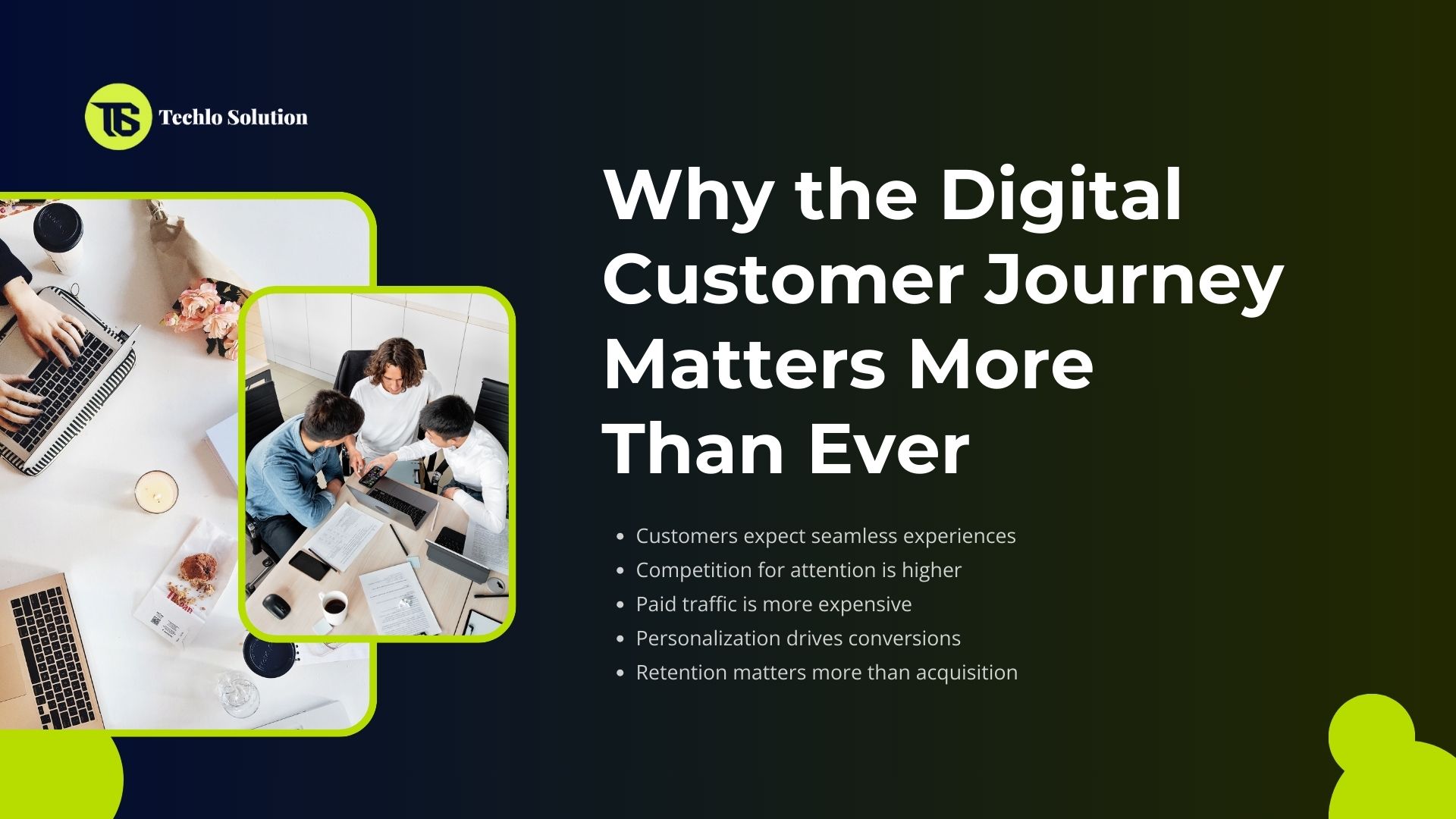
- Customers expect seamless experiences
- Competition for attention is higher
- Paid traffic is more expensive
- Personalization drives conversions
- Retention matters more than acquisition
In the US market, brands that invest in end-to-end digital customer journey optimization consistently outperform those focused only on traffic or ads.
Customer Journey Stages: Awareness to Retention
Although the journey is nonlinear, it still includes core stages.
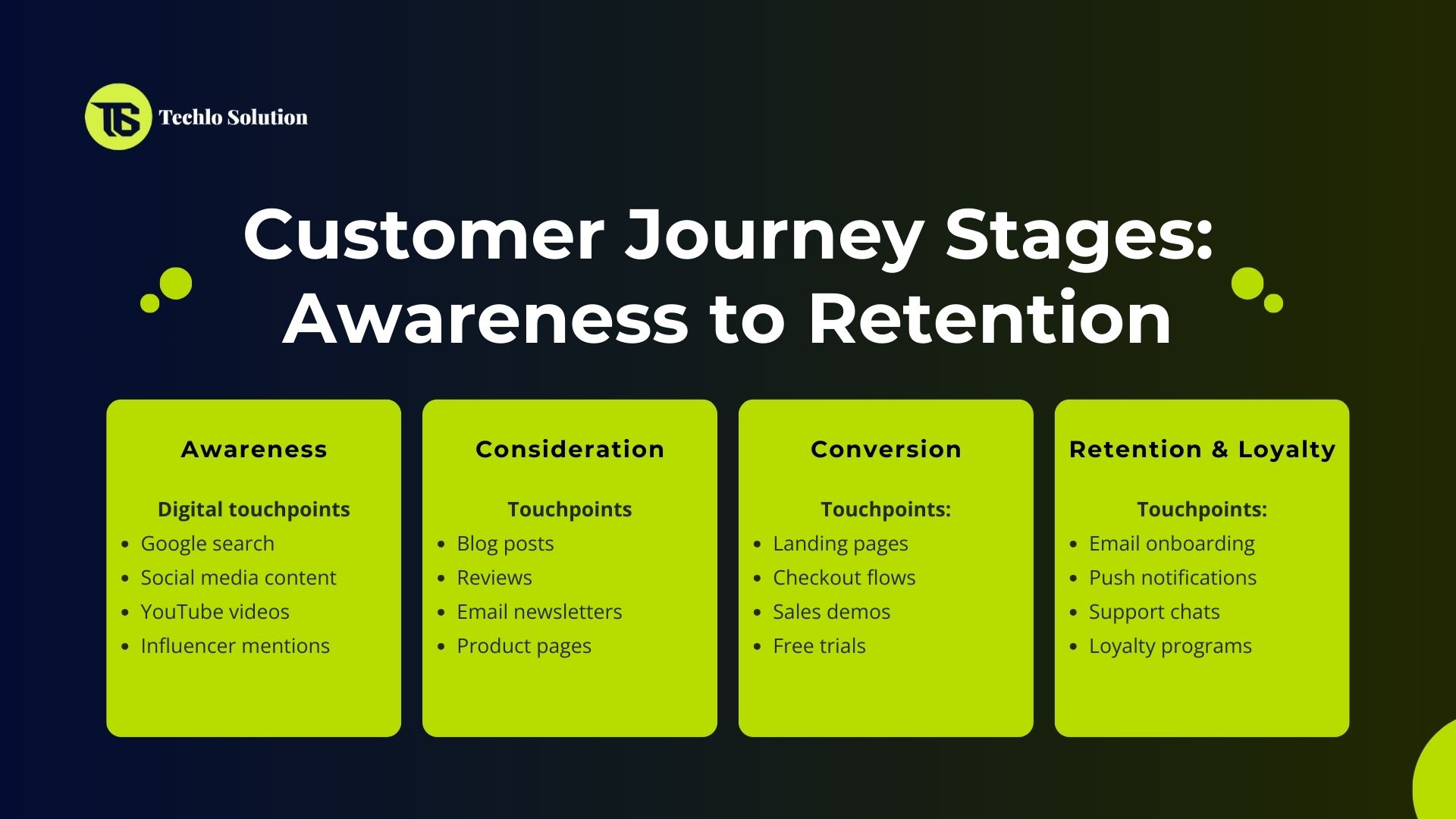
1. Awareness
The customer realizes they have a problem or need.
Digital touchpoints:
- Google search
- Social media content
- YouTube videos
- Influencer mentions
2. Consideration
The customer compares solutions and brands.
Touchpoints:
- Blog posts
- Reviews
- Email newsletters
- Product pages
3. Conversion
The customer takes action.
Touchpoints:
- Landing pages
- Checkout flows
- Sales demos
- Free trials
4. Retention & Loyalty
The customer stays engaged after purchase.
Touchpoints:
- Email onboarding
- Push notifications
- Support chats
- Loyalty programs
Understanding these customer journey stages awareness to retention is the foundation of journey mapping.
Digital Customer Journey Mapping Explained
Digital customer journey mapping is the process of visualizing how users interact with your brand across channels.
Why Journey Mapping Is Critical in 2026
- Identifies friction points
- Improves conversion paths
- Aligns teams around the customer
- Supports personalization strategies
Simple Journey Map Example
Search → Blog → Email Signup → Product Demo → Purchase → Follow-up Email
This approach helps marketers design a data-driven customer journey strategy.
Omni channel Customer Journey in 2026
The Omni channel customer journey in 2026 goes beyond being “present everywhere.”
It means:
- Connected data across channels
- Consistent messaging
- Seamless transitions
Example (US Retail Brand)
- The customer sees Instagram ad
- Searches for the brand on Google
- Visits website on mobile
- Buys in-store
- Receives email follow-up
Disconnected channels break trust. Connected journeys build loyalty.
Digital Touchpoints Across the Customer Journey
In 2026, brands manage dozens of digital touch points across the customer journey.
Key touch points include:
- Search engines
- Social platforms
- Websites & apps
- Chabot’s
- CRM systems
Marketers must optimize each touch point, not just ads.
AI-Driven Customer Journey: The New Standard
AI-driven customer journey strategies are no longer optional.
AI helps marketers:
- Predict customer behavior
- Personalize content in real time
- Automate messaging
- Optimize conversion paths
AI Personalization in Marketing
Examples:
- Personalized homepage content
- Product recommendations
- Predictive email timing
- Dynamic ad creatives
AI enables real-time customer engagement at scale.
B2C vs B2B Digital Customer Journey Frameworks
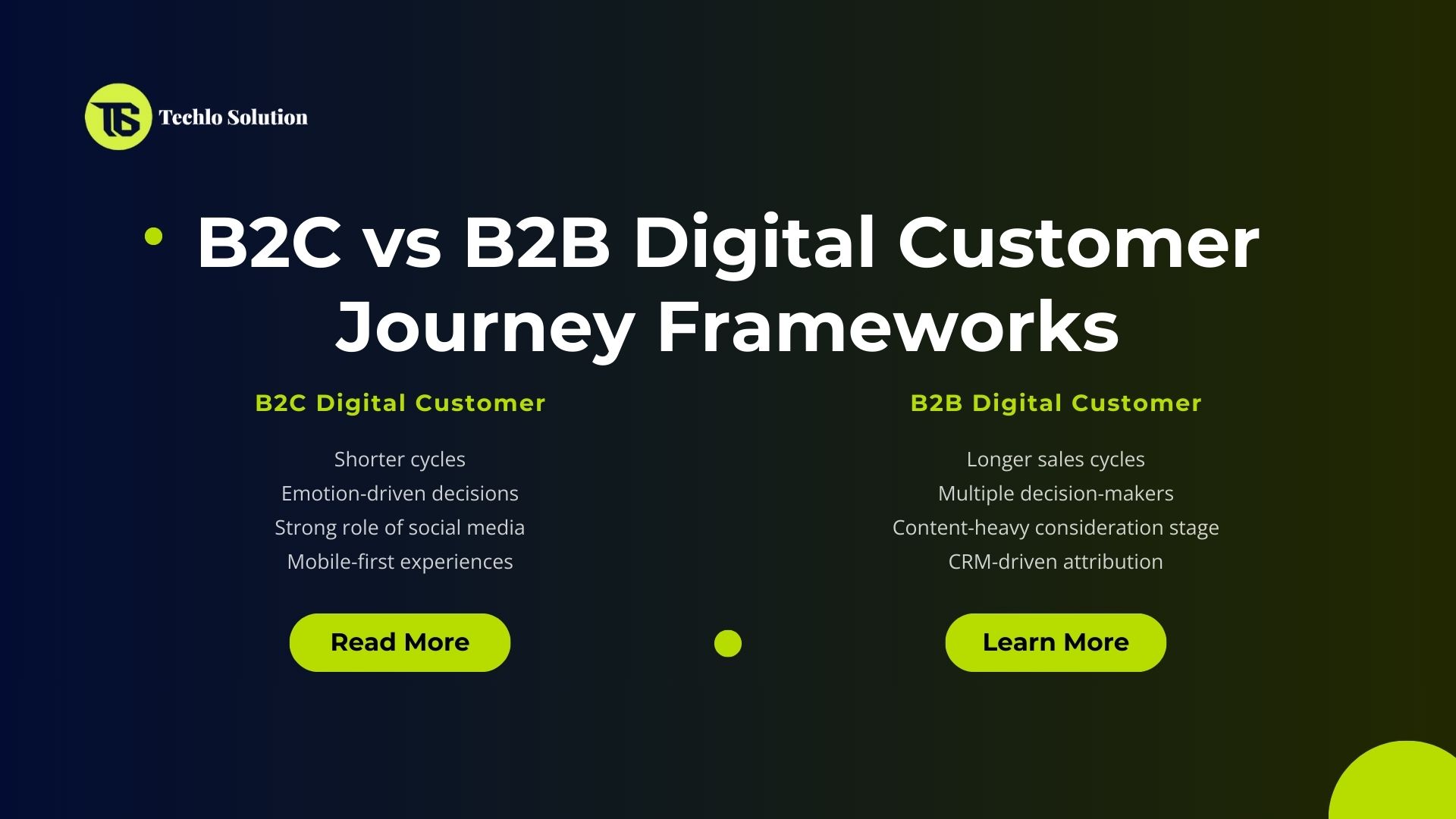
B2C Digital Customer Journey Framework
- Shorter cycles
- Emotion-driven decisions
- Strong role of social media
- Mobile-first experiences
B2B Digital Customer Journey Mapping
- Longer sales cycles
- Multiple decision-makers
- Content-heavy consideration stage
- CRM-driven attribution
Both require a tailored customer journey strategy for digital marketing.
Data, Privacy, and Customer Journeys in the USA
With privacy regulations and cookie limitations, first-party data and customer journeys are essential.
Privacy-First Customer Data Strategy
- Use consent-based data
- Rely on CRM and email lists
- Leverage server-side tracking
- Focus on trust and transparency
This is especially important for US-based marketers.
Measuring the Digital Customer Journey ROI
You can’t improve what you don’t measure.
Key Metrics:
- Conversion rates
- Drop-off points
- Time to conversion
- Customer lifetime value
- Attribution paths
Modern marketing attribution models help identify which channels truly drive value.
Conversion Path Optimization Tips (2026 Ready)
To improve results:
- Reduce steps to conversion
- Improve page speed
- Use clear CTAs
- Align messaging across channels
- Test continuously
These tactics improve measuring customer journey ROI and overall performance.
Customer Journey Trends in 2026
Important customer journey trends for 2026 include:
- Predictive customer journey modeling
- AI-powered personalization
- Automation across lifecycle stages
- Experience-focused metrics
- Cross-channel analytics
Staying updated is key for growth marketers.
My Real-World Experience Learning Digital Marketing
When I first started learning digital marketing, understanding the digital customer journey felt confusing. Terms like “funnels,” “touch points,” and “attribution” sounded complex. At the beginning, I made the mistake of focusing only on traffic, SEO keywords, blog posts, and rankings without thinking about what happens after users arrive.
Over time, I realized that traffic alone does not create results. When I started analyzing how users from the United States moved from search results to content and then to engagement and conversion, everything became clearer. Tools like Google Search Console helped me see real user behavior, not assumptions. At one stage, I focused too much on optimizing individual pages instead of improving the entire journey. Once I shifted my mindset to helping users at each stage from awareness to retention, my content performance and engagement improved. For beginners and marketers alike, understanding the customer journey is not about shortcuts; it’s about patience, learning from data, and designing experiences that genuinely help people.
Common Mistakes Marketers Make with Customer Journeys
Avoid these pitfalls:
- Focusing on single channels
- Ignoring retention
- Over-automation without strategy
- Poor data integration
- Measuring vanity metrics only
A strong end-to-end digital customer journey avoids these errors.
Conclusion: The Digital Customer Journey Is the Strategy
In 2026, marketing success is not about channels—it’s about experiences.
Marketers who understand the digital customer journey in 2026 can:
- Personalize at scale
- Improve ROI
- Build long-term loyalty
- Compete in crowded US markets
Call-to-Action (CTA)
- Audit your current customer journey
- Map key digital touch points
- Optimize one stage at a time using data
The future of marketing belongs to those who design journeys, not just campaigns.
FAQs – Digital Customer Journey (SEO)
What is the digital customer journey in 2026?
It’s the full, Omni channel experience a customer has with a brand, powered by data and AI.
Why is customer journey mapping important?
It helps identify gaps, improve conversions, and create better experiences.
How does AI impact the customer journey?
AI enables personalization, prediction, and automation across all stages.
Is the customer journey the same for B2B and B2C?
No. B2B journeys are longer and more complex than B2C.
How can marketers measure journey performance?
Through analytics, attribution models, and lifecycle metrics.
✍️ Author Bio (E-E-A-T)
Written by Techlo Solution
Digital Marketing Learner & SEO Practitioner
Helping beginners, students, and marketers understand online marketing in simple words.