

Imagine pouring your heart into a blog post only to see it buried on page 5 of Google results. You know your topic inside out. The writing feels solid. Yet U.S. readers never find it. Sound familiar?
Google will reward material in 2026 that genuinely benefits people rather than just stuffs it with keywords. As a content writer in the United States, you have a huge advantage: American searchers are active, local, and quick to bounce from unhelpful pages. Mastering SEO content writing tips for beginners can turn your articles into traffic magnets for everything from New York startups to Texas small businesses.
This guide is written in simple English for beginners. You’ll discover practical SEO writing tips for content writers, step-by-step processes, and 2026 trends that actually work. No fluff. Just actionable advice you can use today on your WordPress blog. By the end, you’ll have a complete content writing checklist for SEO and the confidence to create posts that rank.
What Is SEO Content Writing and Why Beginners in the USA Need It Now
SEO content writing means creating helpful articles, blog posts, and web pages that match what people search for while delivering real value. It combines clear writing with smart optimization so Google (and your readers) love your work.
For U.S. content writers, this matters more than ever. Americans perform billions of searches daily, many with local intent like “best coffee shops in Chicago” or “how to file taxes in California 2026.” Good SEO writing tips for content writers help you capture that traffic and build trust fast.
In 2026, Google’s Helpful Content Update continues to punish thin, AI-spun articles. Sites that focus on people-first content see higher rankings and better engagement. Beginners who learn these basics early avoid common mistakes and grow faster.
Your Complete SEO Content Writing Tips for Beginners Checklist (2026)
Print this checklist and keep it handy:
- Research search intent before writing
- Choose the right primary and secondary keywords
- Write a compelling meta title and description
- Use proper heading structure (H1-H3)
- Place keywords naturally
- Create scan able, readable content
- Add internal links
- Optimize for featured snippets
- Demonstrate E-E-A-T
- End with a clear call-to-action
Follow this every time and your content will rank higher.

Step 1: Keyword Research for Content Writers
Start with keyword research for content writers. Use free tools like Google Keyword Planner or Answer The Public to find what Americans actually search.
Pro tip: Target long-tail keywords with local flavor, such as “SEO content writing tips for beginners in Texas” or “how to write SEO-friendly content for small business owners in Florida.” These have less competition and higher conversion.
Aim for a mix: one primary keyword per post plus 4–6 secondary ones. Tools like SEMrush or Ahrefs show search volume and difficulty—perfect for U.S. beginners.
Understanding Search Intent in Content Writing
Search intent is the reason behind the query. Google wants content that satisfies it perfectly.
Four main types:
- Informational (“what is SEO content writing”)
- Navigational (“best SEO tools 2026”)
- Transactional (“buy keyword research tool”)
- Commercial investigation (“SEO writing tips review”)
Always ask: What does the searcher want? Answer that first. This single habit improves rankings more than any keyword trick.
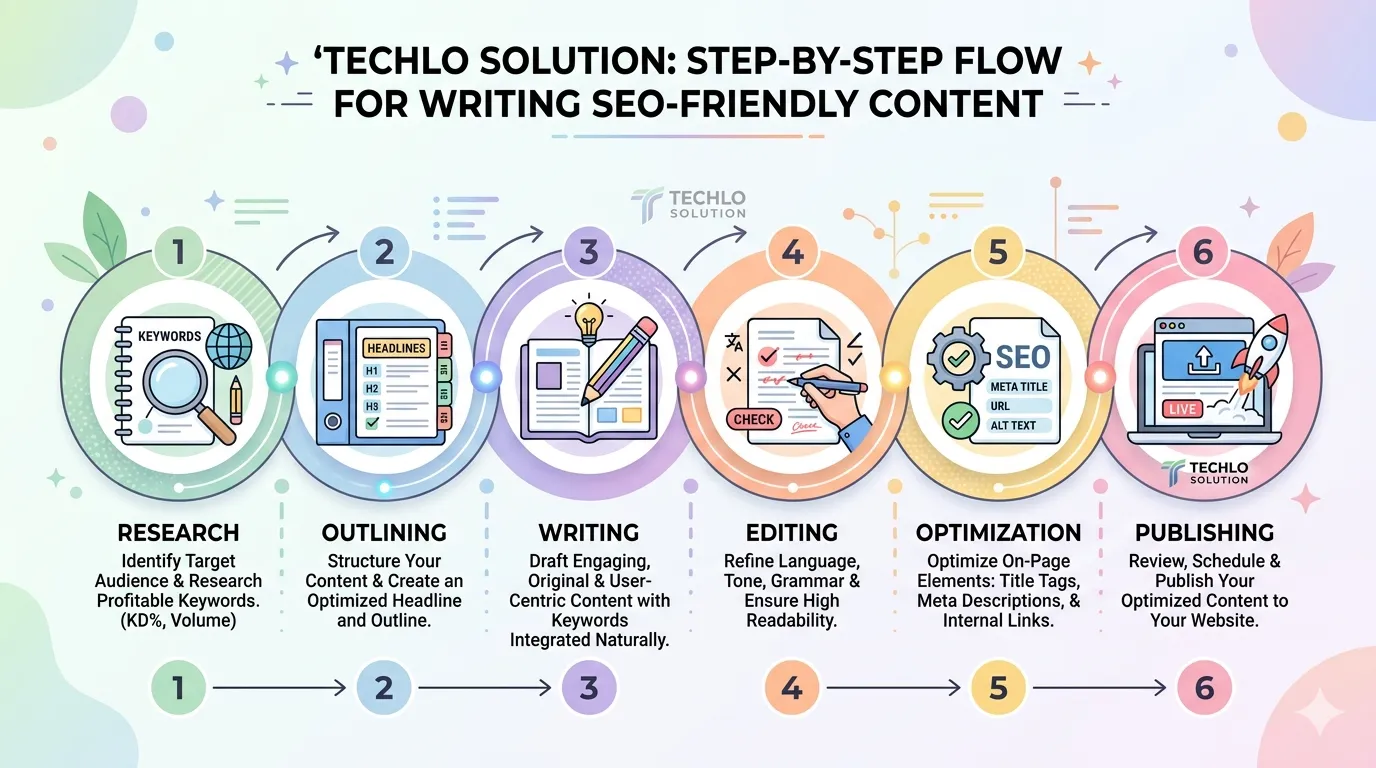
How to Write SEO-Friendly Content: A Simple Process
Here’s how to write SEO-friendly content in 2026:
- Pick one clear topic and primary keyword.
- Outline with H2 and H3 headings that match user questions.
- Write the first draft for humans—ignore SEO rules.
- Revise for natural keyword placement in content writing.
- Add examples, bullet points, and short paragraphs.
- Optimize images with alt text.
- Proofread for readability.
This process turns average posts into high-ranking ones.
 On-Page SEO Writing Techniques That Work
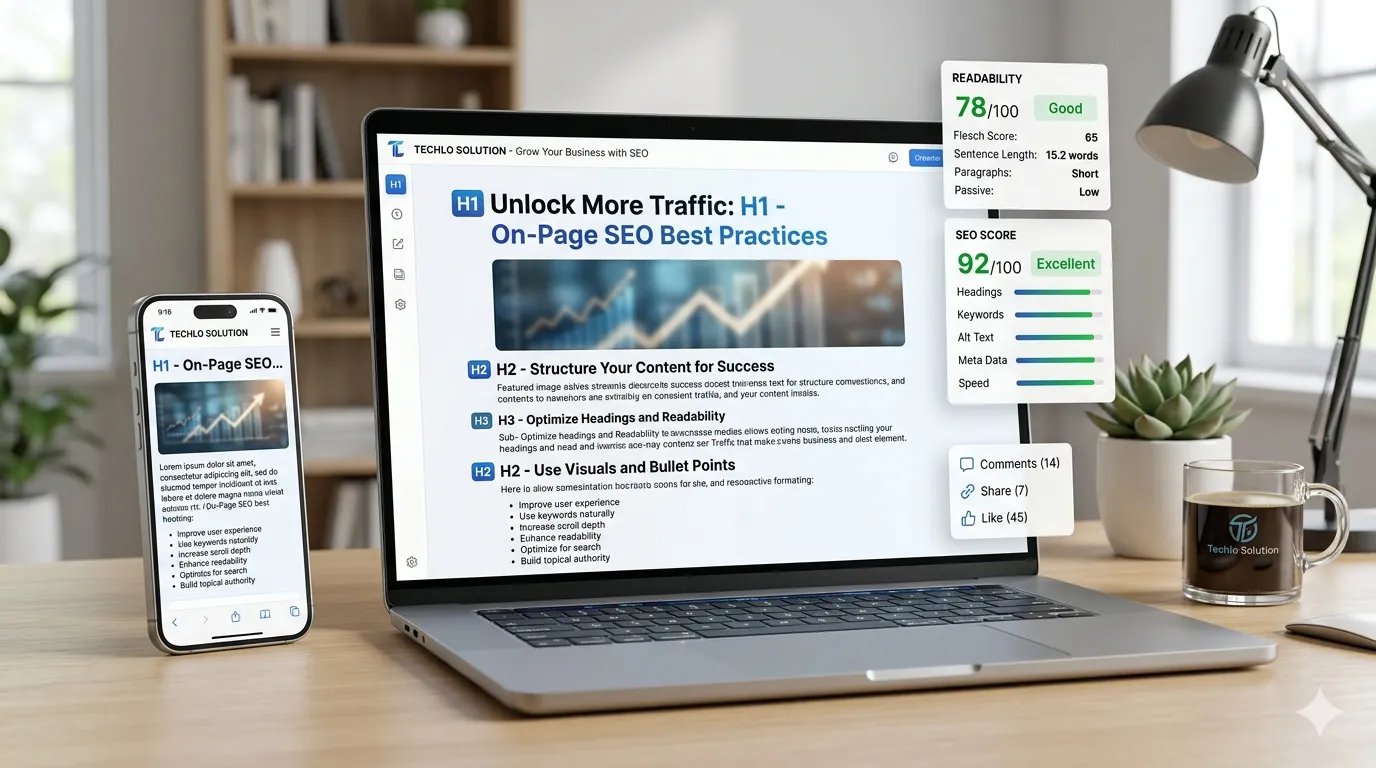
On-page SEO writing techniques focus on elements you control inside the article.
- Meta title and meta description writing: Keep titles under 60 characters and descriptions under 160. Include your primary keyword naturally. Example title: “SEO Content Writing Tips for Beginners: 12 Ways to Rank Higher in 2026”
- Heading structure (H1, H2, H3) SEO: Use one H1 per page. H2s for main sections. H3s for sub-points. This helps Google understand your article and improves scan ability.
- Content formatting for SEO: Short paragraphs (3–4 lines max), bold key phrases, numbered lists, and tables. U.S. readers skim on mobile—make it easy.
These techniques boost both rankings and time-on-page.
Blog Writing for SEO Best Practices
Blog writing for SEO best practices in 2026 means quality over quantity.
- Publish consistently (1–2 posts per week).
- Focus on long-form content SEO tips: 1,500–3,000 words for in-depth topics.
- Answer every possible reader question.
- Update old posts with fresh 2026 data.
U.S. brands that maintain active blogs see 55% more traffic on average. Your blog becomes an asset that keeps working for years.
SEO Copywriting Tips That Rank
SEO copywriting tips that rank go beyond keywords. They persuade while informing.
- Speak directly to the reader (“you” language).
- Use storytelling with real U.S. examples.
- Include data-backed insights (e.g., “Google data shows helpful content gets 3x more clicks”).
- End sections with mini CTAs.
Avoid keyword stuffing—Google detects it instantly and penalizes.
Keyword Placement in Content Writing Done Right
Natural keyword placement in content writing is an art:
- Primary term in H1 and the first 100 words.
- Naturally in subheadings.
- In the first and last paragraphs.
- 1–2% density maximum.
Secondary keywords appear in body text and image alt tags. Read your draft aloud—if it sounds forced, rewrite.
SEO Article Writing Step by Step
Follow this SEO article writing step by step:
- Research topic and intent.
- Create a detailed outline.
- Write an introduction that hooks in 10 seconds.
- Deliver value in body with examples.
- Add visuals and internal links.
- Write a conclusion with CTA.
- Optimize on-page elements.
- Publish and promote.
Repeat and watch your Google rankings climb.
Your Content Writing Checklist for SEO
Use this content writing checklist for SEO before hitting publish:
- Does it answer the searcher’s question completely?
- Is E-E-A-T clear (author bio, sources, experience)?
- Readability score above 60 (Flesch-Kincaid)?
- Mobile-friendly formatting?
- Internal links to 3–5 related posts?
- Featured snippet opportunity (list or table)?
Check yes to all and you’re ready.
How to Optimize Blog Posts for SEO
How to optimize blog posts for SEO after writing:
- Add schema markup for articles (if using WordPress plugins).
- Compress images and add descriptive alt text.
- Ensure fast load time (under 3 seconds).
- Submit URL to Google Search Console.
- Share on social with compelling snippets.
For U.S. local SEO, mention city or state naturally when relevant and encourage readers to share location-specific experiences.
Writing High-Quality SEO Content in the Age of AI
Writing high-quality SEO content means showing real experience. Google’s 2026 Helpful Content Update favors writers who share first-hand knowledge.
Tips:
- Include personal stories or case studies.
- Cite reputable U.S. sources (HubSpot, Search Engine Land).
- Update statistics yearly.
- Be transparent about limitations.
Quality beats quantity every time—10 excellent posts outperform 50 average ones.
Building an SEO Content Strategy for Writers
An SEO content strategy for writers gives direction:
- Create topic clusters around pillar pages.
- Plan 3–6 months ahead.
- Monitor results in Search Console and Google Analytics.
- Repurpose top content into emails or social posts.
U.S. content writers who follow a strategy see steadier traffic growth.
Long-Form Content SEO Tips
Long-form content SEO tips that work:
- Cover a topic thoroughly (no gaps).
- Use subheadings every 300 words.
- Add tables comparing options.
- Include FAQs section.
Long posts (2,000+ words) often rank for multiple keywords and keep readers longer.
How to Make Content Readability Better for SEO
Content readability for SEO matters because Google measures user signals like bounce rate.
- Aim for 8th–9th grade reading level.
- Use short sentences (under 20 words average).
- Break up text with bullets and images.
- Tools like Hemingway App or Yoast SEO help.
Readable content keeps U.S. visitors engaged longer—boosting rankings.
How to Write Engaging SEO Content
How to write engaging SEO content:
- Start with a question or bold statement.
- Use conversational tone.
- Add relatable U.S. examples (e.g., “Like a small business owner in Los Angeles struggling with local search…”).
- Ask rhetorical questions.
- End sections with “What do you think?” style transitions.
Engagement signals tell Google your content deserves higher placement.

E-E-A-T in Content Writing: The 2026 Game Changer
E-E-A-T in content writing (Experience, Expertise, Authoritativeness, Trust) is now central.
Show it by:
- Adding a detailed author bio.
- Linking to your past work or credentials.
- Citing studies and including dates.
- Being honest about what you don’t know.
Google’s quality raters look for these signals. U.S. writers who demonstrate real expertise rank higher and build loyal audiences.
Writing for Featured Snippets and Position Zero
Writing for featured snippets increases visibility dramatically.
Tips:
- Answer questions directly in the first paragraph.
- Use numbered or bulleted lists.
- Create simple comparison tables.
- Target “how to,” “what is,” and “best” queries.
Many U.S. searches now show snippets first—owning them drives massive traffic.
SEO Tools for Content Writers Every Beginner Should Use
Best SEO tools for content writers in 2026:
- Google Keyword Planner (free)
- SEMrush Writing Assistant
- SurferSEO or Fraser for optimization
- Grammarly for clarity
- Yoast SEO or Rank Math (WordPress plugins)
- Hemingway App for readability
Start with free versions and upgrade as you grow.
Local SEO Elements for USA Content Writers
Include local SEO elements for the USA by:
- Mentioning specific states or cities when relevant.
- Creating location-specific guides.
- Encouraging readers to comment with their city.
- Adding local schema if selling services.
This helps your content appear in “near me” searches that dominate U.S. mobile traffic.
Authoritative Resources for SEO Content Writing (2026 Guide)
SEO content writing is the backbone of ranking on search engines. To improve writing quality, keyword optimization, and search visibility, these trusted resources from Google, HubSpot, Moz, Ahrefs, and SEMrush will help you create high-performing content in 2026.
- Moz Beginner’s SEO Guide – Covers keyword research, on-page SEO, and content optimization basics.
- HubSpot SEO Content Writing Guide – Step-by-step guide for writing SEO-optimized blog posts and web content.
- SEMrush SEO & Content Marketing Blog – Advanced SEO writing strategies, keyword research, and content optimization techniques.
Strong Conclusion: Start Applying These SEO Content Writing Tips Today
You now have everything you need: SEO content writing tips for beginners, a full checklist, and proven 2026 strategies. The biggest secret? Write for real people first, then optimize.
Start small. Pick one blog post this week and apply just three tips from this guide. Track results in Google Search Console after 30 days. You’ll see the difference.
Ready to rank higher? Leave your biggest SEO writing challenge in the comments below. Or open your WordPress editor right now and improve one old post using the checklist. Your future traffic—and readers—will thank you.
My Real-World Experience Learning Digital Marketing
When I first started learning digital marketing, terms like SEO, Google Ads, and content marketing felt overwhelming. I honestly thought this field was only for tech experts, but with consistent practice, I realized that beginners can learn digital marketing step by step. I first made the mistake of attempting to understand everything at once, which only led to confusion. Once I focused on one skill at a time, especially SEO basics, my understanding improved significantly. While learning SEO, I discovered that simply adding keywords is not enough. When I started writing content to genuinely help users, I noticed organic traffic from the United States slowly growing. Many students enter digital marketing expecting quick income, but based on my experience, focusing on learning and real practice first always leads to better long-term results. Using tools like Google Search Console helped me understand what people are actually searching for. At first, it felt confusing, but regular use made it easier to analyze real user behavior. I used to write more for search engines than for actual readers. Once I shifted my approach to helping people first, my content performance improved. If you have patience and believe in the learning process rather than taking short cuts, digital marketing can be a viable and future-proof career for students or beginners.
That real shift—from chasing rankings to helping readers—changed everything for me. It will for you too.
CTA: Call-to-Action Click Here
Today, optimize your Google Business Profile, collect 10 new reviews, and launch one local ad campaign. Small actions lead to big growth.
Your competitors are already online — it’s time you are too.
FAQs About SEO Content Writing Tips for Beginners
What are the best SEO content writing tips for beginners in 2026?
Focus on people-first content, natural keywords, strong structure, and E-E-A-T signals. Write to help readers, not just to rank.
How do I improve content readability for SEO?
Use short paragraphs, simple words, bullet points, and tools like Hemingway App. Aim for an 8th-grade reading level.
Does long-form content still work for SEO?
Yes—when it thoroughly answers user questions and demonstrates real expertise. Quality matters more than word count.
How important is E-E-A-T in content writing?
Extremely important in 2026. Google favors content from writers who show real experience and trustworthiness.
Should I use AI tools for SEO article writing?
AI can help with outlines and research, but always add your own insights and edit heavily for a human voice.
What is the best way to optimize blog posts for SEO?
Follow the checklist: proper headings, keyword placement, internal links, fast images, and clear meta tags.
Can these tips help with local SEO in the United States?
Absolutely. Adding local examples and intent helps your content rank in city-specific and “near me” searches.
✍️ Author Bio (E-E-A-T Fix)
Written by Techlo Solution
Digital Marketing Learner & SEO Practitioner
Helping beginners and students understand online marketing in simple words.