
A Practical, ROI-Focused Guide for Business Owners in the United States
In today’s fast- paced digital world, it’s not enough to just do good
marketing you also need to know if your marketing is working. That’s why understanding marketing pretensions and KPIs (crucial performance indicators) has come essential for every marketer, business owner, and student. This guide will give you a deeper understanding of the concepts in the environment of 2026.
What are marketing goals?
When a business starts marketing, the first question it asks is: “What do we want to achieve?” Marketing goals are the answer to that question. Simply put, marketing goals are specific outcomes you want to achieve through your marketing activities.
A marketing goal isn’t just an idea — it’s a clear, measurable goal. Just as a student might have a goal of “I want a 90% grade,” a marketer might have a goal of “I want 5,000 new customers in a quarter.” Marketing with no goals is like traveling with no goals — you just keep walking, you don’t know where to write.
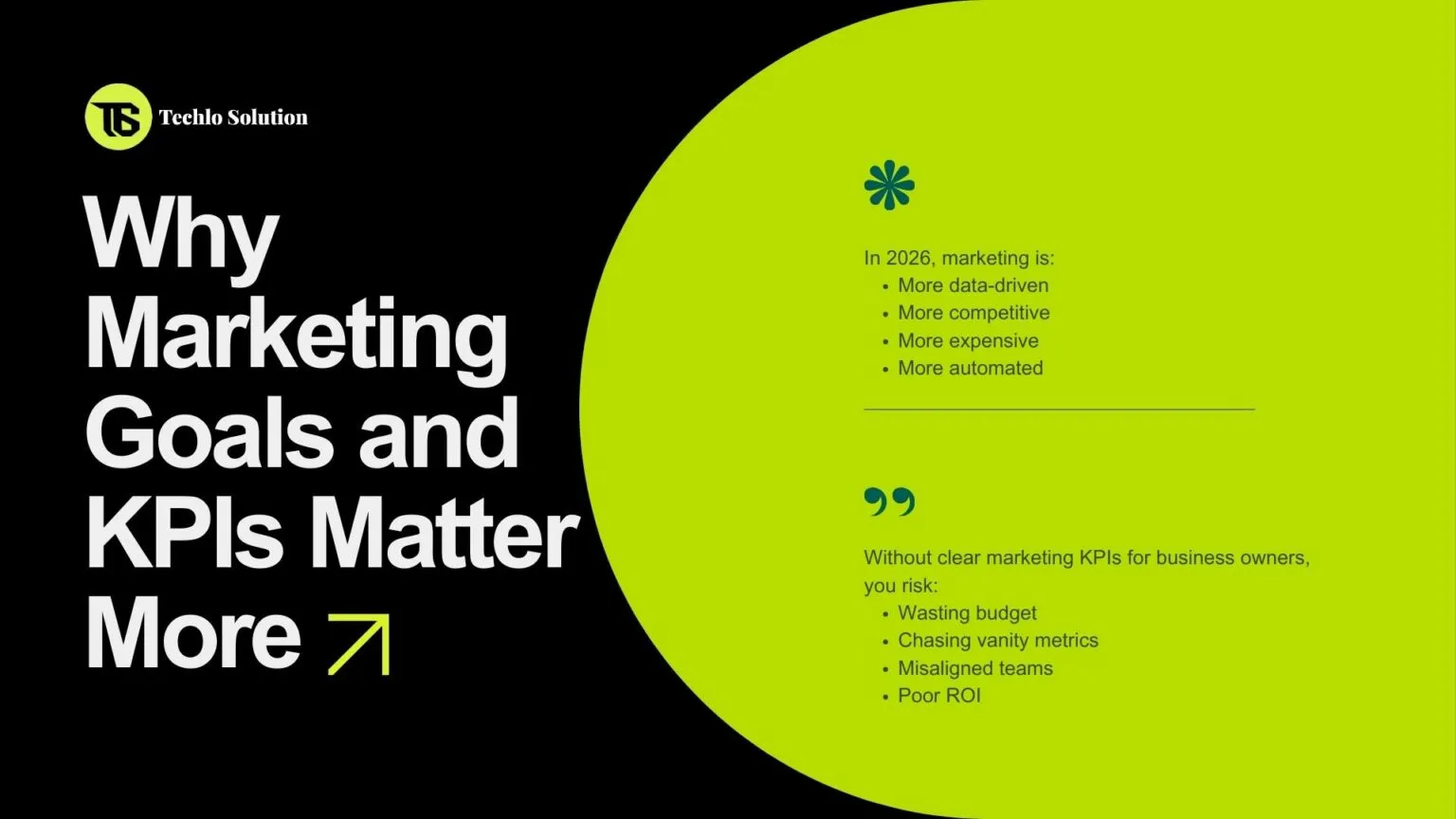
In 2026, data-driven marketing goals will become even more important. Companies no longer talk about vague things like “brand awareness” — they talk with numbers, think with timelines, and measure results.
SMART Goals Framework — Not Surf Theory, Real Tool
The most popular and proven way to set goals in marketing is the SMART Framework. It’s a powerful 5-letter method:
Letter | Meaning | Example |
S | Specific | Email subscribers have reached 10,000. |
M | Measurable | will be tracked by Google Analytics |
A | Achievable | Realistic achievable current rate. |
R | Relevant | The business of oral speech is connected to purpose. |
T | Time-bound | In the next 3 months |
This framework is especially important for students because it helps you break free from vague thinking. When you create SMART goals, your entire team works in the same direction and accountability comes naturally.
KPIs (Key Performance Indicators) — Marketing Plus
KPIs (Key Performance Indicators) are specific metrics that tell you how fast you’re moving toward your marketing goals. If marketing goals are your destination, then KPIs are the signposts that guide you along the way.
Many people get confused between goals and KPIs. Let’s take a simple example to understand: Your goal is “50% more website traffic.” The things you track to achieve that goal — like organic search clicks, bounce rate, session duration, pages per visit — are all you’re KPIs.
In 2026, KPIs aren’t just numbers — they’ve become decision-making tools. Today’s AI-powered dashboards and real-time analytics tools have made it easy for even small businesses to use their data effectively.
Types of Marketing KPIs — Complete Breakdown.
- A. Awareness KPIs
These KPIs measure how numerous people are apprehensive of your brand. When you’re new to the market or launching a new product, these KPIs are most important. Crucial criteria include website traffic, social media impressions, brand search volume, voice reach, and share. For a growing brand, these KPIs tell you whether your awareness campaigns are working.
- B. Engagement KPIs
After awareness comes engagement — are people probing or indeed interacting with you? Engagement KPIs include click- through rate (CTR), social media likes commentary shares, email open rate, time on page, and comments per post. High engagement means your content is reverberating and the followership is authentically interested.
- C. Conversion KPIs
These are KPIs that are directly tied to revenue. Conversion rate — that is, how numerous visitors come real customers is every marketer’s agony. The main conversion KPIs are bring per accession( CPA), super eminent generation rate, sales qualified leads( SQLs) or profit per campaign.
- D. Retention KPIs
Attracting a customer is one thing, but retaining them is an indeed bigger task. Retention KPIs measure how effectively you retain your living guests. These include client lifetime value (CLV), churn rate, net promoter score (NPS) and repeat purchase rate.
Real Case Study Spotify’s Data- Driven Marketing Goals.
Spotify set a goal for 2023- 2024 to grow its podcast listener base. Their SMART goal was “Grow podcast yearly active users from 100 million to 130 million in 6 months.” What specific KPIs are set to achieve the goal — Podcast Start Rate, hear- Trough Rate (LTR), or diurnal Active Listeners?
Tracked KPIs daily, identified underperforming genres, and bettered individualized recommendations. Result? They reached their goal 3 weeks beforehand and LTR bettered from 68 to 79. This surfer did not set goals, chose the result of KPIs.
Marketing Goals vs. Business Goals Understand the Difference.
Numerous students and beginners make a common mistake — they suppose business goals and marketing goals are the same thing. There’s a clear difference in writing them down.
A business goal is broad — like “Will the company have$ 2M in profit this year?” This goal is n’t driven by marketing, but rather by deals, operations, and product development. A marketing goal, on the other hand, is specific — “We’ll induce$ 800K in profit and induce 3,000 new leads through digital campaigns.”
An effective marketing strategy is one that aligns marketing goals directly with business goals. Without alignment, the marketing department works in isolation and does n’t contribute to the overall success of the company.
Top Marketing KPIs in 2026 — What Every Marketer Should Track
The digital marketing landscape has changed dramatically in 2026. AI- generated content, voice search, short- form video, and privacy-first advertising and marketing KPIs have also evolved. Then are the top KPIs that matter in today’s competitive marketplace.
KPIs that matter in today’s competitive marketplace
KPI | What is available? | Why is it important in 2026? |
Customer Acquisition Cost (CAC) | Cost of acquiring a new customer | Costs are rising, you need to |
Marketing ROI | Return on investment comparison | The poor now don’t just cry, they see the behavior. |
Content Engagement Rate | How much is the content advancing? | Differentiating between Haman content in an e-content flood |
First-Party Data Growth | Directly collected customer data | Third-party cookies are expiring. |
Video Completion Rate | Video viewing rate | Two prohibitions of short-form video |
Share of Search | Brand’s satellite engine is Persnickety | So + Brand Awareness Combined Metric |
Real Case Study HubSpot’s Content Marketing KPI System
HubSpot — the world’s leading inbound marketing company — uses a cutting- edge KPI system to drive its growth. The primary goal is “40 further leads than organic search.” What’s the goal? The primary KPIs are chosen organic traffic growth rate, user conversion rate, or ROI per content post.
Their approach was to concentrate on “high- intent” keywords, not high- volume keywords. Not only did the strategy increase their traffic, but the quality of their leads also bettered. In 18 months, their organic traffic increased by 55 and their conversion rate went from 3.2 to 5.1 — proof that the KPIs they chose were important.
Marketing Funnel and KPIs Connection
An effective marketer always understands the marketing funnel and sets separate KPIs for each stage. The marketing funnel is divided into three crucial stages
Top of Funnel (TOFU) — Awareness stage this is your job to reach as numerous people as possible. KPIs Impressions, Reach, Website Visits, Social Followers. Success in this stage means your brand exposure is on the rise.
Middle of Funnel (MOFU) — Consideration stage here’s where you need to go, now you need to believe. KPIs super eminent generation, email signups, webinar attendees, demo requests, CTR. This is where quality content and targeted communication are most important.
Bottom of Funnel (BOFU) — Decision stage there’s where implicit customers are making a purchase decision. KPIs Conversion rate, sales qualified leads, profit generated, cart abandonment rate. Can a one percentage point improvement in stage make a million bucks difference?
Pro tip for students whenever giving a marketing interview or presenting a case study, always state which stage of the funnel your KPIs are aligned to. This is a sign that you’re thinking strategically, not superficially.
Common Mistakes Marketers Make When Setting KPIs
Tracking just KPIs is not enough — tracking the right KPIs is essential. Then are some common mistakes that new marketers make
Focusing on vanity metrics “We’ve 50,000 followers on Instagram!” but if those followers are not buying, are not engaging, then that number is empty. Vanity metrics look good but do not contribute to business growth. Always choose practicable metrics.
Tracking Too numerous KPIs Tracking 20 KPIs at once can be confusing. Uses the concept of a North Star metric — a core KPI and 3- 5 supporting metrics representing the core value of your business.
Disconnecting from KPI Goals If your goal is client retention and you’re tracking acquisition metrics, you’re going in the wrong direction. Each KPI should directly support a goal.
Not reviewing daily Setting KPIs and forgetting them is a big mistake. Successful marketing teams have daily “KPI review meetings” where data is reviewed and strategies are acclimated.
Tools That Make KPI Tracking Easier (2026)
Marketing analytics tools have become much more advanced in 2026. Some crucial tools you should know about
Google Analytics 4(GA4) is now the industry standard and provides event- grounded tracking, AI- powered insights, and cross-platform attribution. It’s a free tool that’s essential for website KPIs.
HubSpot Marketing Hub is an each- by- one platform that provides super eminent tracking, email analytics, social media KPIs, and CRM integration in one place. Especially useful for B2B companies.
Semrush and Ahrefs are industry- leading tools for SEO KPIs keyword rankings, backlink profiles, organic traffic trends are each tracked. Bringing in transnational traffic is a no- brainer.
Meta Business Suite and LinkedIn Analytics are essential for social media KPIs. LinkedIn B2B marketing has become increasingly influential in 2026, and its analytics are now much grainier.
Real Case Study: Nike’s Global Marketing KPI Transformation
Nike revamped its entire KPI system in 2024 to strengthen its direct-to-consumer (DTC) strategy. Their main goal was: “Increase direct digital sales by 40% while reducing reliance on third-party retail.” What KPIs are not for: Nike App daily active users, Nike Plus membership growth rate, or direct channel revenue share?
What did the transformation do that make Nike realize that customer data is its greatest asset? Train your marketing team on KPIs to collect first-party data. The result was that Nike’s direct digital revenue grew to 43% of total revenue in 2025, up from 27% in 2022. This was not a marketing success — it was a business transformation that could be made possible by setting KPIs.
Step- by- Step Process for Setting Marketing Goals
Now that you understand the theory, let’s look at how marketing goals are set in practice
Step 1 — understand the business objectives first, understand the overall business strategy of the company. What do the CEO and leadership want to achieve? Your marketing goals should be directly linked to the objectives.
Step 2 — Baseline current performance to get to where you want to go, first set where you are. Assaying data from the last 3- 6 months establishes the baseline and metrics.
Step 3 — Write pretensions in a SMART format Set each goal within a SMART framework. Transfigure vague goals like “Ameliorate social media” into specific goals “Instagram engagement rate increased from 2.1 to 3.5 in 3 months.”
Step 4 — Assign Applicable KPIs to the Core Choose 2- 3 KPIs for each goal that will measure progress toward your goal. Avoid over-committing KPIs
Step 5 — Review the Cadence Set Decide when and how frequently you’ll review KPIs — weekly, biweekly, or yearly. Whether to block the schedule on a calendar.
2026 New Realities for My Marketing Goals
The 2026 marketing landscape brings new challenges and opportunities that directly impact your goals and KPIs
The impact of AI and automation Generative AI tools and content production are dramatically changing the speed and cost of content creation. Now marketers have time to think strategically. Writing also means that happy quality KPIs no longer measure surf volume, but engagement and conversion impact.
Sequestration-first world Third- party eyefuls are nearly gone. Companies must now strengthen their first- party data strategy. Are email list growth, app downloads, and loyalty program enrollments in context?
Short- form video dominance YouTube Shorts, Instagram Reels, and TikTok are changing consumer attention patterns. Video completion rates, save rates, and shares per view are now important KPIs for marketers.
Transnational traffic and localization if you’re targeting a transnational audience, you’ll want to track geo-specific traffic, original conversion rates, and indigenous engagement metrics. A strategy that works for the US market may perform else in the Middle East or Southeast Asia.
Conclusion — KPIs are not surf figures, they’re your marketing language
There are no shortcuts to success in marketing — there’s a proven path. The path to success starts with clear goals, continues with the right KPIs, and ends with data- driven decisions. In 2026, marketers who are not only creative but also logical will be at the forefront.
The biggest takeaway for students is this whenever you take on a marketing project or campaign — whether in college or on the job — first ask “What’s our goal and how will we use it?” This simple question will set you piecemeal from the average marketer crowd.
Flash back marketing goals are your destination, KPIs are your GPS, and data is the path that guides you. Use them together, and your marketing will be not just good it’ll be great in terms of measurement.
Authoritative Resources for Marketing Goals & KPIs (2026 Guide)
Understanding marketing goals and KPIs is essential for tracking performance, improving ROI, and making data-driven decisions. The following trusted resources from industry leaders and official platforms will help you master KPI tracking and marketing measurement strategies in 2026.
- HubSpot KPI Dashboard & Reporting Guide – Understand how KPI dashboards help businesses monitor performance in real time and improve decision-making.
- Moz SEO Learning Center – Complete guide to SEO metrics, keyword performance, and tracking KPIs for organic growth.
- Shopify KPI Tracking Guide – Learn how eCommerce businesses track KPIs like conversion rate, CAC, and customer lifetime value.
Call-to-Action (CTA)
- Write down your top 3 marketing goals
- Choose 5 KPIs that connect to revenue
- Track them consistently for 90 days
Clear goals + the right KPIs = smarter growth.
FAQs – Marketing Goals & KPIs (SEO)
What are marketing goals and KPIs?
Goals define what you want to achieve; KPIs measure progress.
How many marketing KPIs should a business track?
5–10 focused KPIs are enough for most businesses.
Are KPIs different for small businesses?
Yes, small businesses should focus on simple, revenue-related KPIs.
How often should KPIs be reviewed?
Monthly reviews work best for most US businesses.
Do KPIs guarantee marketing success?
No, but they help you make better decisions faster.
✍️ Author Bio (E-E-A-T)
Written by Techlo Solution
Digital Marketing Learner & SEO Practitioner
Helping beginners, students, and business owners understand online marketing in simple words.